
Global Women’s Summit Highlights How AI Is Reshaping Education Worldwide
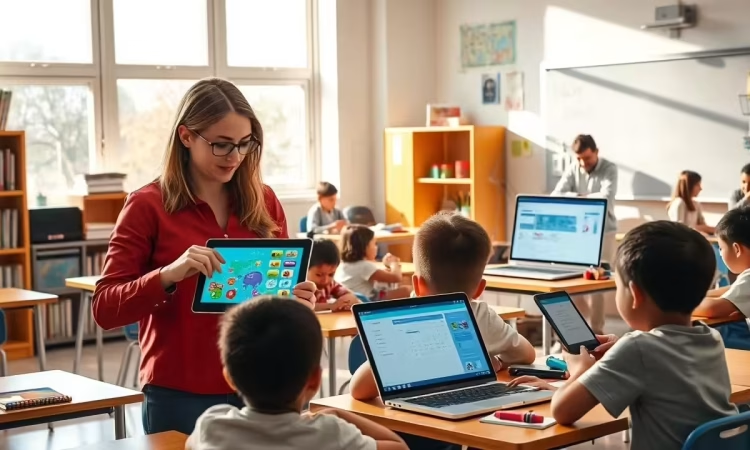
The Global Women’s Summit, held this week in Geneva, brought together educators, policymakers, technology leaders, and social-impact advocates from over sixty countries. While the annual event traditionally celebrates women’s leadership and innovation, this year’s spotlight was unmistakably on one theme: the rapid transformation of education through artificial intelligence. From redesigned classrooms to personalized learning platforms, speakers emphasized that AI is no longer a distant concept but an active force reshaping the future of teaching and learning worldwide.
Over three days, the summit explored how AI-driven technologies are increasing access to education, strengthening teaching methods, and equipping the next generation for a rapidly changing world. The discussions revealed both immense opportunities and important challenges that governments, institutions, and communities must address to ensure equitable progress.
AI as a Tool for Inclusion and Access
One of the overarching messages at the summit was the role AI can play in breaking long-standing barriers to education. In many developing regions, limited access to trained teachers, quality materials, or specialized instruction has hindered student growth for decades. AI-powered platforms are now offering solutions that were once unimaginable.
Key examples included:
- Virtual tutors supporting students in rural areas
- Real-time translation tools enabling cross-lingual learning
- Adaptive lessons adjusting to individual learning speeds
Several panelists emphasized that AI’s ability to deliver personalized instruction is particularly impactful for girls in marginalized communities, where traditional barriers such as cultural restrictions, distance, or safety concerns may limit access to school.
According to delegates from South Asia and East Africa, AI-enabled remote learning tools have already helped thousands of students continue their education despite shortages of teachers or disruptions caused by natural disasters. These technologies are proving especially powerful in crisis situations, ensuring continuity in learning even when physical classrooms are inaccessible.
Reinventing the Role of Teachers
Another topic that dominated the summit was how AI is reshaping the role of teachers. While early debates about AI in education often centered around fears of replacing human instructors, the conversation this year was more nuanced and optimistic. Experts agreed that AI should serve as an assistant—not a substitute—helping teachers focus on the human aspects of teaching that machines cannot replicate.
AI can assist teachers by:
- Analyzing large batches of assignments quickly
- Preparing lesson plans
- Suggesting individualized activities
- Tracking student progress in real time
Educators at the summit shared firsthand experiences of how AI has lightened their administrative workload. One teacher from Brazil described using an AI dashboard that highlights which students are struggling and recommends targeted interventions. Another from Japan showcased how classroom robots help students practice languages through conversation, building confidence and engagement.
Yet, despite these advances, teachers underscored the importance of comprehensive training. Without proper support, many educators may feel overwhelmed by unfamiliar digital tools. Summit speakers called on governments to invest in professional development programs that empower teachers to use AI confidently and responsibly.
Emerging Technologies Transforming Classrooms
Beyond personalized learning tools, the summit also showcased emerging AI technologies that are redefining what a modern classroom can look like. Augmented reality (AR), virtual labs, and predictive analytics systems are enabling learning experiences that were once limited to imagination.
Examples demonstrated included:
- AI-driven simulations for complex science experiments
- Immersive, AI-supported storytelling for history lessons
- Predictive analytics for early intervention
Delegates also highlighted how AI-supported education can prepare students for future job markets. With industries evolving rapidly due to automation and digital technologies, integrating AI literacy into school curriculums has become essential. Several countries, including Canada, Singapore, and the United Arab Emirates, shared their initiatives to embed coding, data literacy, and ethical AI training into school programs from early grades onward.
Women Leading the Future of AI in Education
A distinctive feature of this year’s summit was the strong emphasis on women’s leadership in AI innovation. Panels celebrated women entrepreneurs, engineers, and educators developing AI tools that prioritize inclusivity and fairness. Many speakers argued that women must play a central role in shaping AI technologies to prevent biases and ensure that solutions reflect diverse perspectives.
Showcases at the event included women-led startups that design accessible learning apps for students with disabilities, platforms that monitor algorithmic fairness in classrooms, and mentorship programs that encourage girls to pursue careers in STEM and AI.
Several delegates stressed that global cooperation is needed to ensure women worldwide have opportunities to contribute to AI advancements. They called for investments in STEM education for girls, funding for female-led projects, and supportive policies that enable women innovators to scale their impact.
Ethical and Policy Considerations
Despite the enthusiasm surrounding AI’s potential, the summit also addressed important ethical considerations. Concerns regarding data privacy, algorithmic transparency, and digital inequalities were central to discussions.
Speakers urged policymakers to establish clear regulations that protect students while still encouraging technological innovation. They also warned of the growing digital divide between schools with advanced infrastructure and those without. Without significant investment in connectivity, electricity, and devices, AI’s benefits may remain out of reach for millions.
Additionally, experts emphasized the importance of teaching students to think critically about AI—not just how to use it, but how it works, its limitations, and its ethical implications.
A Vision for the Future
By the end of the summit, one message stood out: AI is reshaping education more quickly and profoundly than any technology before it. Its potential to personalize learning, support teachers, expand access, and create immersive classrooms is immense. But realizing this potential requires collaboration across governments, industries, and communities.
The Global Women’s Summit concluded with a call to action: to ensure AI becomes a tool for empowerment rather than exclusion. With thoughtful implementation, ethical safeguards, and inclusive leadership—especially by women—the future of education can become more innovative, more equitable, and more human-centered than ever before.








