
NASA and Google Use Artificial Intelligence to Find New Exoplanets
The Search for Alien Planets Just Got More Intense; AI May Have Found 2 New Ones.
NASA and Google Are Testing an AI Space Doctor
Could Artificial Intelligence Save Astronauts in Deep Space?
When humans venture from the relative safety of Earth to explore deep space, we take more than just food, water, and oxygen. They carry risk. From medical emergencies to ordinary health checks, astronauts have always relied on down-linked support from Earthbound doctors. But with space agencies planning future missions to Mars and beyond, the time lag in communicating with Earth—up to 20 minutes each way—makes real-time medical support nearly impossible.
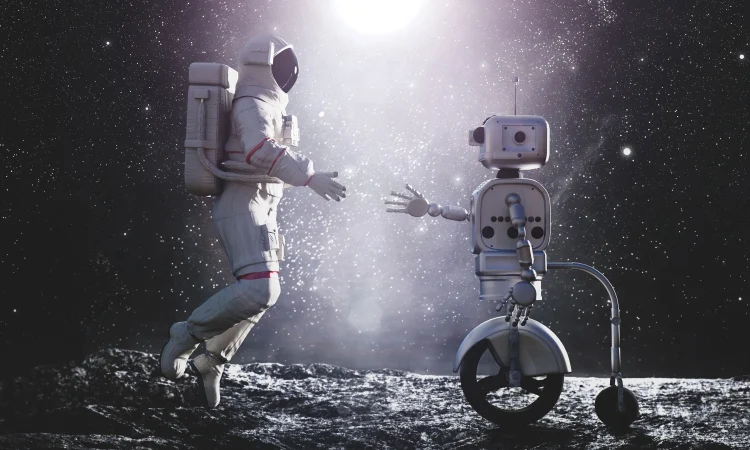
Today, NASA and Google are testing out a bold idea that could aid future deep-space missions: an artificial intelligence system designed to act as a “space doctor.” This AI-powered medical assistant could help guide astronauts through diagnosis, treatment, and even emergency procedures—and it may become a central tool for future space exploration.
The Medical Challenge of a Voyage to Mars
Even in low Earth orbit aboard the ISS, astronauts face significant health threats:
- Microgravity Effects: Long-term exposure weakens muscles, decreases bone density, and damages cardiovascular function.
- Radiation Exposure: Increases long-term cancer risk and impacts cellular health.
- Vision Problems & Immune Changes: Prolonged missions alter eyesight and immune system function.
On the ISS, communication with Earth is almost instantaneous, enabling NASA flight surgeons to assist with medical issues in real time. But on a Mars mission, delays of up to 20 minutes make immediate support impossible. An astronaut might experience a medical crisis without a doctor nearby or quick access to Earth’s expertise.
This is where artificial intelligence steps in.
Google AI Meets NASA Medical Standards
Google’s AI expertise in natural language processing combined with NASA’s decades of medical research in space has produced an AI system tailored for healthcare. Unlike general-purpose chatbots, this system is:
- Specialized for Medicine: It processes symptoms and creates diagnostic treatment plans.
- Capable of Reading Scans: It interprets ultrasound and other spacecraft imaging techniques.
- Guided by Context: It offers treatment options and decision support for astronauts.
Example Scenario:
If an astronaut on the way to Mars feels dizzy and short of breath, the AI could:
- Walk them through measuring vital signs.
- Help interpret results.
- Suggest whether it’s dehydration or a cardiovascular event.
- In emergencies, guide crew members through administering medication or even performing robotic-assisted surgery.
NASA stresses that the AI is not a replacement for doctors but an advanced tool—essentially, a digital medical officer on call, 24/7, regardless of distance from Earth.
How the AI Space Doctor Works
The system integrates several advanced technologies:
- Symptom Identification & Diagnosis
- Trained on vast datasets to recommend possible conditions.
- Medical Imaging Analysis
- Interprets ultrasounds and imaging tools available on spacecraft.
- Decision Support
- Provides step-by-step guidance, recommends treatments, and flags high-risk conditions.
- Offline Operation
- Purpose-built to function without internet or ground support.
Importantly, the AI does not make autonomous decisions—it offers advisory suggestions. Astronauts remain in control.
Testing in Extreme Environments
Before deployment in space, the AI is tested in Earth-based analogs that simulate isolation and limited medical access:
- Antarctic Research Stations
- Underwater Habitats
These environments replicate the conditions of deep space missions. In tests, the AI:
- Diagnoses and treats simulated medical emergencies.
- Guides non-medical personnel through complex procedures.
- Produces recommendations comparable to trained physicians.
Early results show AI can be a reliable partner in high-stakes situations, though rigorous testing continues before Mars missions.
Medicine Meets Mars: Health Challenges on the Red Planet
Astronauts undergo basic medical training, but they are not doctors. In high-stress situations, recalling advanced medical procedures is unrealistic. The AI’s conversational approach delivers clear, step-by-step instructions in everyday language.
Beyond physical health, the AI may support mental well-being:
- Helping astronauts monitor mood and stress.
- Offering coping strategies for long-duration space missions.
- Providing psychological support during isolation.
The Far-Out Future of Space Exploration
The AI space doctor could transform human spaceflight. On two-to-three-year missions, self-sufficiency is critical. Crews will need:
- Food production systems.
- Repair capabilities.
- Reliable medical support.
Artificial intelligence offers a solution that blends technology with human care.
Potential Benefits for Earth
This technology could also help:
- Remote Villages with limited medical access.
- Disaster Zones where doctors are scarce.
- Ships at Sea far from hospitals.
Just like GPS and water filtration—technologies born from space programs—the AI doctor could benefit millions of people on Earth.
Challenges and Concerns
Despite its promise, several hurdles remain:
- Accuracy & Reliability – Medical errors in space could be fatal.
- Moral Responsibility – If AI makes a mistake, who is accountable?
- Trust – Astronauts must trust AI guidance but avoid blind reliance.
- Adaptability – AI must handle unknown medical scenarios, not just familiar conditions.
NASA and Google aim to solve these challenges with robust training, backup protocols, and human oversight.
The Road Ahead
As NASA prepares for its Artemis program, which will return humans to the Moon as a stepping stone to Mars, the AI space doctor may soon see its first real tests. Lunar missions could provide critical data before attempting longer journeys.
Ultimately, the AI space doctor represents a vision of cooperation between humans and technology. It could ensure astronauts not only survive but thrive during interplanetary exploration.
Conclusion
When humans first set foot on Mars, they will be far from hospitals and emergency rooms. Instead, they may rely on an AI space doctor, a system forged through collaboration between NASA and Google.
This concept is not just a machine—it is a lifeline, a companion, and a symbol of human ingenuity. It may one day guide humanity across the vast distances of space while also improving healthcare back on Earth.








