
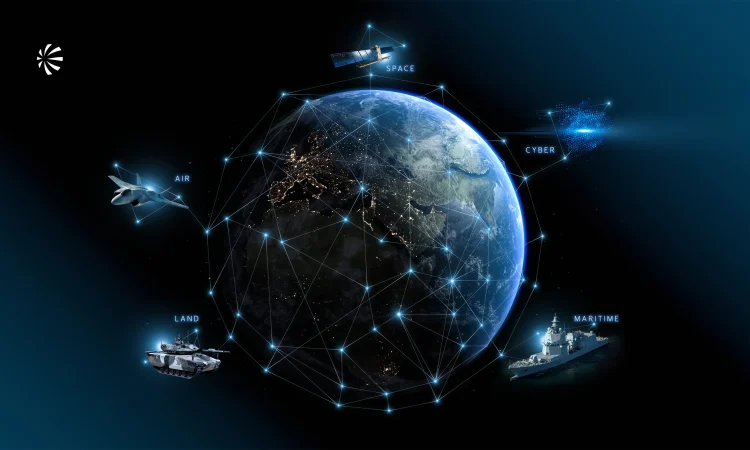
Italian defence and aerospace leader Leonardo has unveiled its groundbreaking air-defence system, the Michelangelo Dome. This marks a major step forward in Europe’s defence capabilities, offering a fully integrated, AI-driven architecture designed to safeguard critical infrastructure, cities, and strategic assets in Italy and allied nations.
What is the Michelangelo Dome?
Unlike traditional missile batteries or single-purpose systems, the Michelangelo Dome is a comprehensive defence network. It connects sensors, command systems, and effectors across land, sea, air, and even space, creating a unified protective shield against modern threats.
The system’s central command infrastructure uses AI-powered data fusion for real-time threat analysis, decision-making, and rapid response coordination. It’s designed to handle a wide range of challenges—from conventional missiles and hypersonic weapons to drone swarms and hybrid cyber-kinetic attacks.
Why the Michelangelo Dome Matters
Europe faces growing threats from missiles, drones, and hybrid warfare. Leonardo’s CEO, Roberto Cingolani, highlights that the Dome reflects a commitment to protecting citizens and infrastructure with advanced, forward-looking technology.
Its open, modular design allows allied countries to integrate their own defence systems, boosting strategic autonomy while maintaining interoperability. Strategically, it positions Italy as a key player in European defence innovation and self-reliance.
Mission and Capabilities
The Michelangelo Dome is built to protect:
- Critical civil infrastructure: airports, energy plants, industrial zones, and urban centers.
- Military installations: air bases, naval ports, and command facilities.
- Coastal and maritime zones: surface and underwater threats via naval sensors.
- Air and space domains: intercepting missiles, hypersonic vehicles, aircraft, and drones.
- Hybrid threats: including cyber attacks, kinetic strikes, and coordinated multi-domain operations.
In practice, it forms a protective dome, detecting threats early, coordinating responses, and neutralizing dangers with optimal efficiency.
Timeline and Collaboration
The Michelangelo Dome is moving beyond concept. Leonardo’s engineers and military personnel are actively developing it to meet Italy’s defence needs. Full operational capability is expected by 2028.
Italy’s Defence Minister stresses its role in countering modern hybrid warfare, especially threats to energy and transportation hubs. Talks are underway with European partners to expand the system’s protective reach beyond Italy.
Distinguishing Features
The Dome stands out because of:
- Multi-domain integration: covering air, land, sea, space, and cyber.
- Scalability and modularity: nations can add their platforms and assets.
- AI and predictive analytics: anticipates threats for faster, smarter responses.
- European strategic autonomy: strengthens regional resilience while reducing reliance on foreign systems.
European Security Context
Europe’s security landscape is evolving, with increasing risks from drones, hypersonic missiles, and hybrid warfare. Traditional systems often fail to address complex, multi-layered threats.
Michelangelo Dome offers a forward-looking, integrated solution. It aligns with EU and NATO efforts to standardize and enhance air-defence capabilities while promoting continental cooperation.
Challenges Ahead
Implementing such a multi-domain, AI-powered system is challenging. Coordinating sensors across all domains requires advanced technology, strong cybersecurity, and significant investment. Integrating assets from multiple nations adds political, logistical, and technical complexity. Real-world testing will be crucial, especially against hypersonic and hybrid threats.
Strategic Implications
For Italy, the Dome signals national defence leadership and technological excellence. For Europe, it provides a model for shared protection, allowing countries to pool sensors and resources. Globally, it reflects a shift from isolated, single-domain defence to interconnected, AI-driven shields capable of countering modern multi-domain threats.
Conclusion
The Michelangelo Dome represents a next-generation vision of defence: smart, integrated, and adaptable. It combines Italy’s engineering expertise, European collaboration, and cutting-edge technology to create a protective dome against increasingly sophisticated modern threats.








