
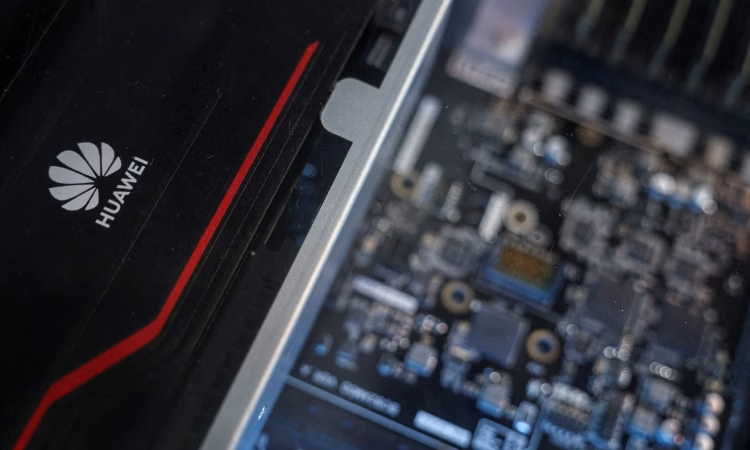
In a daring play to reconfigure the artificial intelligence (AI) core, Chinese tech powerhouse Huawei has introduced a new range of AI hardware that is squarely taking on Nvidia’s established hegemony in the sector.
The news, announced at the 2025 World Artificial Intelligence Conference in Shanghai, represents a high-water mark in the AI industry, as the high-performance computing race enters a new phase of competition.
A New Contender in AI Chips
Nvidia has long reigned in AI hardware with its powerful GPUs (graphics processing units), which have become the industry standard for training and running large AI models. From tech heavyweights like Google and Microsoft to startups, companies wanting to transform the way computers recognize speech, interpret images, and understand the written word have been beholden to a company little known outside the AI community: Nvidia.
Huawei’s new Ascend AI chips, however, are poised to rewrite that story.
The company’s new AI chip, the Ascend 910B, delivers performance numbers that on paper rival—and in some cases surpass—Nvidia’s flagship GPUs. Huawei says the chip can achieve up to 512 teraflops of mixed-precision computing, while also being more energy efficient.
That not only makes it faster in some AI workloads but also far more cost-effective to operate at scale, according to the company’s engineers.
“This is an issue about more than just catching up with Nvidia,” said Xu Zhijun, Huawei’s rotating chairman, during the product launch.
“We’re setting a new standard for AI computing.”
The Battle for AI Infrastructure
The market for artificial intelligence hardware has emerged as one of the hottest sectors in global technology.
AI models are getting bigger and more complex, demanding tremendous computational power for their construction and deployment. The increased demand for high-quality AI chips has turned this into a multi-billion-dollar industry.
Nvidia has ridden this demand with its H100 and A100 GPUs, which have rapidly become the workhorses of AI research and development worldwide.
However, the increased reliance on a single supplier has raised concerns about:
- Supply-chain bottlenecks
- Skyrocketing prices
- Geopolitical risks, particularly as the U.S. cracks down on chip technology exports to China
Huawei’s Strategic Move
Huawei’s advance becomes strategically important in this context.
By creating its own homegrown alternative to Nvidia’s AI chips, Huawei is not only entering the market but also providing a work-around for Chinese companies and organizations that have been hampered by U.S. sanctions.
Effectively, Huawei’s new hardware gives China a path to AI independence—much like:
- Qualcomm helped China become independent in smartphone technology
- Microsoft, Intel, and Google enabled China to develop independent Internet operations
Technical Breakthroughs of Huawei’s AI Chips
Huawei’s Ascend series has been in development for years, but the 910B marks the company’s first major breakthrough.
Key Technical Features:
- 5-nanometer fabrication technology
- High-bandwidth memory integration
- Leading-edge AI accelerators
- Revolutionary chip-to-chip interconnect for massive scalability in large data centers
One of the chip’s key selling points is its enhanced efficiency for AI training.
While GPUs are versatile, working well for everything from gaming to medical imaging, Huawei’s Ascend processors are specifically optimized for AI workloads, enabling:
- Faster matrix operations
- More efficient neural network calculations
- Quicker training of large language models (LLMs), computer vision systems, and other deep learning applications
The MindSpore Advantage
Huawei has also developed MindSpore, an AI development framework designed to compete with industry-standard platforms like TensorFlow and PyTorch.
MindSpore is optimized for Ascend chips, providing developers with:
- A seamless software-hardware suite
- Simplified deployment
- Improved performance efficiency
Global Implications and Market Reactions
News of Huawei’s announcement is reverberating through the global tech community.
Nvidia has long maintained a near-monopoly in the AI chip market, and its stock price has soared alongside the AI boom. But the rise of a formidable rival like Huawei introduces a new level of competition that could transform the industry.
“The AI hardware market is hitting a new phase,” said Kevin Krewell, principal analyst at TIRIAS Research.
“If Huawei can become what it claims and scale up production successfully, it will be a major player—not only in China, but globally.”
Challenges Ahead
Despite the promising advancements, Huawei faces significant challenges:
- U.S. export restrictions limit Huawei’s access to cutting-edge chip-making equipment
- Replicating Nvidia’s vast ecosystem of partners, software tools, and developer support will be difficult
Nvidia’s Countermove
Nvidia is not standing still. The company has announced its next generation of GPUs, code-named Blackwell, which it claims will offer even greater AI performance in the coming years.
Additionally, Nvidia’s global partnerships with:
- Cloud providers
- Universities
- AI research labs
…give it a huge head start.
The Geopolitical Dimension
Huawei’s rise is not just a technology story—it’s also about geopolitics.
The United States has sought to block China’s access to advanced semiconductors, citing national security concerns. In response, China is accelerating efforts to build a self-sufficient chip industry, with Huawei emerging as a central force in that mission.
By announcing high-performing AI chips, Huawei is making it clear that it will not be sidelined by Western sanctions.
Its Ascend hardware allows Chinese firms and research bodies an alternative to Nvidia’s GPUs, potentially insulating China’s AI ambitions from future restrictions.
A Potential Technological Split
Some experts caution this could lead to technological bifurcation, where global AI development separates into two distinct ecosystems:
- One led by U.S. technology
- Another built on Chinese advances
What’s Next?
Time will tell whether Huawei can truly break Nvidia’s stranglehold on the market or simply establish a competitive foothold.
Huawei’s Plans:
- Accelerate production of the Ascend 910B
- Partner with Chinese cloud providers and AI startups
- Build new data centers powered by Ascend chips
- Invest heavily in:
- Software development
- Developer tools
- AI research
For now, Nvidia remains the market leader, but the game is afoot.
Huawei’s AI hardware breakthrough is ushering in a new phase of the global tech contest, promising:
- Faster innovation
- More diverse competition
- A new balance of power in the world of artificial intelligence








