
Google Opens Up Access to the Third-Party Data AI Needs to Learn
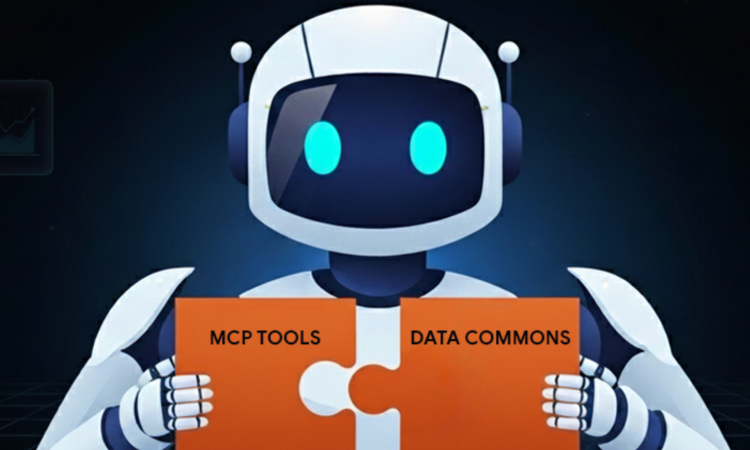
In a move that may prove instrumental in driving progress in artificial intelligence (AI), Google has rolled out an all-new system to enable real-world data to be more easily used by AI models. This innovation will facilitate easier AI training pipelines, simplify development, and improve the reliability and accuracy of AI outputs across industries.
What Will Google’s New Data Initiative Look Like?
The search giant’s new tool is built on top of its Data Commons, a database repository that compiles publicly available data from sources like government reports, international compilations, and local administrations.
While these data sources are not new, historically, accessing them meaningfully for AI training has been difficult. Developers often had to:
- Wrangle complex API integrations
- Sanitize messy data
- Manage integration struggles
All of these challenges have slowed down AI development.
To address this, Google is launching a system where AI models can ask questions about real-world data using natural language queries.
Key points of this system:
- AI can request particular data in natural language and receive accurate, structured datasets instantly.
- Removes the need for in-depth knowledge of APIs or underlying data structures.
- Uses large language models as an intelligent interface between the user and the data provider.
Leaders at Google Data Commons stated that this approach allows AI systems to focus on solving real problems rather than figuring out how to retrieve data. By transforming natural language inputs into structured outputs, Google simplifies a critical step in AI development.
Why This Is Important for Training AI
The quality of data is crucial for AI performance. Models trained on noisy, inconsistent, or biased data produce unreliable results.
By providing access to organized, verifiable real-world datasets, Google ensures:
- AI systems are grounded in reality
- Outputs are dependable and accurate
- Specialized domain-specific models (e.g., medical predictions, climate simulations) can be trained efficiently
Additionally, this system democratizes AI development, enabling smaller teams or organizations without dedicated data engineers to build sophisticated AI models.
Practical Applications
The potential applications of Google’s initiative are broad and impactful:
1. Public Health
- Analyze demographic and health data to identify trends
- Assess the impact of interventions
- Enable non-profits and policymakers to make data-driven decisions without requiring deep technical expertise
2. Global Development
- Collaboration between Google and NGOs improves health and economic outcomes in developing regions
- AI-driven applications present millions of data points in a human-digestible format
- Decision-makers can gain faster insights and take action
3. Businesses
- Marketing, finance, logistics, and research teams can integrate real-world datasets into AI pipelines
- Eliminates the need to build custom data infrastructure
- Saves costs, accelerates project timelines, and enables rapid responses to market shifts
Open Access for Developers
Google has made this system publicly available to foster innovation. It can be accessed through:
- Notebooks for experimentation
- Command-line tools
- Python packages for batch processing
Benefits of open access:
- Encourages collaboration and experimentation
- Reduces barriers to high-quality data
- Supports novel model development
- Enhances AI system precision and flexibility
Broader Impact on the AI Ecosystem
Google’s initiative reflects a larger trend toward transparency, accountability, and ethical AI development.
Key implications:
- Verified real-world data ensures AI models are grounded in reality and free from false or biased information.
- System interoperability allows developers to plug datasets into any AI model regardless of architecture.
- Sets a new benchmark for industry standards regarding data access, transparency, and verification.
As AI adoption grows, the demand for high-quality, verifiable data will increase. Systems like this may become critical infrastructure for AI research, commercial applications, and public policy.
Future Prospects
Looking ahead, Google’s system could transform AI model training and deployment:
- Removes data-related roadblocks
- Provides structured data through natural language queries
- Allows developers to focus on creative problem-solving instead of data wrangling
With AI expanding into fields like healthcare, environmental monitoring, finance, and governance, the need for trustworthy real-world data will grow significantly. Google’s platform positions itself as a critical enabler for reliable and verifiable AI systems.
Broader implications include:
- Enhanced decision-making in critical sectors
- Prevention of costly failures
- Increased public confidence in AI-driven systems
- Unlocking progress and innovation for companies, governments, and researchers
Conclusion
Google’s initiative represents an important advancement in real-world data accessibility for AI. By combining:
- Natural language processing (NLP) querying
- Structured datasets
- Open-access models
AI development becomes less complex and more reliable, with models trained on safe, verifiable data.
Beyond technology, this move signals a commitment to a transparent, accountable AI ecosystem. As AI becomes increasingly central to decision-making, reliable training data infrastructure will be essential. Google’s approach not only empowers developers and businesses but also raises the bar for responsible AI development.








