
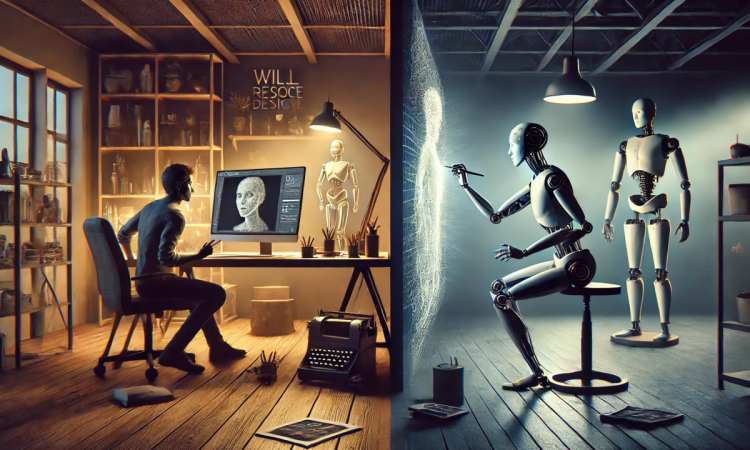
Over the past decade, Artificial Intelligence (AI) has evolved from an intriguing experiment into a game-changing force that’s reshaping industries worldwide. From automating daily business tasks to transforming healthcare, AI has proven it can outperform humans in many analytical and repetitive jobs. But as machines grow smarter, a thought-provoking question emerges: what happens to human creativity? Can algorithms truly create, or are they simply powerful tools that help us imagine more?
The answer lies in transformation, not replacement — a partnership between human imagination and machine intelligence that’s redefining how we create art, music, writing, and design.
Redefining Creativity in the AI Era
For centuries, creativity was seen as something purely human — a mix of emotion, intuition, and personal experience. Artists, musicians, and writers were admired for their unique perspectives and the humanity reflected in their work. But AI is now challenging that idea.
Modern algorithms can compose music, generate lifelike art, write poetry, and even direct films. Tools like ChatGPT, Midjourney, and Runway have shown that machines can produce work that feels emotional and meaningful.
Still, experts argue that AI’s creativity isn’t the same as ours. While AI can mimic creativity by analyzing data patterns and remixing ideas, it lacks the emotional depth, intent, and consciousness that define true human imagination. In short — AI’s creativity is replicative, while human creativity is experiential.
Yet, instead of seeing this as competition, we can view AI as a collaborator — a tool that enhances what we can do. The future of creativity lies in this partnership.
AI as a Creative Partner
More and more creators are embracing AI as a creative ally. Filmmakers use AI for storyboarding and effects, musicians rely on algorithms to compose or remix, and writers use AI to brainstorm or refine their drafts.
These tools act as catalysts — breaking creative barriers and speeding up the process. In digital art, for example, AI platforms like DALL·E and Midjourney let anyone create detailed, imaginative visuals using simple text prompts. This has opened up the art world to people without traditional training, expanding what it means to be an “artist.”
In music, AI programs like AIVA and Amper Music let composers create background scores in minutes. For writers, AI can help overcome creative blocks, test new writing tones, and even co-author content. Instead of replacing writers, AI helps them explore new creative directions that might otherwise stay hidden.
The Rise of “Augmented Creativity”
The blending of AI with human creativity has sparked a new era known as augmented creativity. Here, AI doesn’t replace imagination — it enhances it. By handling repetitive or technical tasks, AI lets creators focus on what truly matters: emotion, storytelling, and purpose.
- A designer can generate hundreds of logo variations instantly and then choose the best one using human intuition.
- A filmmaker can use AI to edit footage faster, freeing time to focus on the story.
This balance of speed and soul shows a simple truth — creativity isn’t about the tools we use but the intention behind their use.
Ethical and Philosophical Dilemmas
As AI becomes a bigger part of the creative process, important ethical questions arise.
- Who owns an artwork made with AI — the user, the programmer, or the algorithm?
- Should AI-generated art be labeled differently?
- Could endless AI-created content make it harder for human artists to get noticed?
These debates are intensifying as AI art wins awards and floods social media. Critics warn that machine-generated work could overshadow human creators or raise copyright concerns, since many AI models learn from existing art without explicit permission.
To address these issues, experts are developing new frameworks for creative ethics and intellectual property. Transparency — openly stating when and how AI was used — and shared credit models are becoming key to ensuring fairness while encouraging innovation.
Educating the Next Generation of Creators
The future of creativity will depend on how we prepare the next generation. As AI becomes more integrated into art and design, creators will need new skills — not just artistic ones, but also technological understanding.
Schools and universities are adapting with courses in AI art, digital storytelling, and computational creativity. The most successful creators of the future will be those who combine emotional intelligence with technological literacy — seeing AI as a collaborator, not a competitor.
A New Creative Renaissance
If the Industrial Revolution mechanized production, the AI Revolution is set to mechanize imagination. Yet this isn’t the end of human creativity — it’s the beginning of a new renaissance.
AI opens doors to worlds we couldn’t have imagined: immersive virtual realities, interactive storytelling, and personalized art experiences. It enables artists to work faster, test ideas instantly, and reach audiences worldwide. But beyond all the tech, one truth remains — creativity is about connection, not perfection.
In the age of AI, the best art will still be born from emotion, empathy, and the human desire to express meaning.
Conclusion
The future of creativity in the age of Artificial Intelligence is a story of evolution, not extinction. AI will continue transforming how art is created and shared, but it can never replace the spark of human inspiration.
Instead, it will push us to rethink creativity — not as a solitary human act, but as a powerful collaboration between people and machines. The next great masterpiece may not come from a single artist or a single algorithm, but from both — working together to redefine what it means to be creative in the modern age.








