
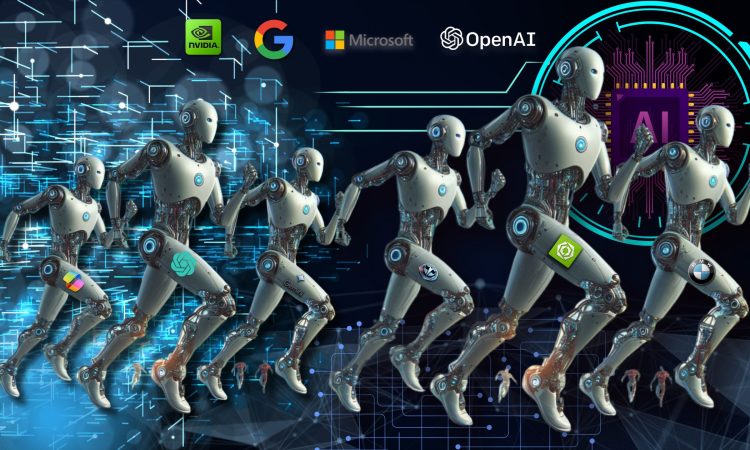
Among the items that a choreographed dance of fidget spinners might illustrate are physical laws, precision mechanical construction, and artificial intelligence.
A New Kind of Dance
Deep in a hush-hush lab somewhere in the heart of the United Kingdom, an entirely new kind of dance is Galton-boarding itself into existence. But this is not your average ballet. Instead of a lineup of prima ballerinas and tutus, the performers are robotic—mechanical arms whirring and spinning with uncanny precision.
The mastermind behind it all isn’t a conductor, but an artificial intelligence built by the London-based research powerhouse DeepMind. Its mission? Ensuring that all robots in a manufacturing environment can perform their work without ever interfering with each other.
Cool as it sounds, the idea may seem like something out of a futuristic sci-fi movie. However, DeepMind’s work demonstrates that this is very much a real and practical application of AI for modern industry.
One of the most elusive and difficult challenges in robotics is deceptively simple: how to enable factory robots to work together safely without slowing each other down. Traditionally, this coordination has been managed through:
- Prescheduled programming
- Static schedules
- Human control
While somewhat effective, these methods are often too rigid, costly, and prone to bottlenecks when unexpected conditions emerge.
Enter DeepMind’s Robotic Ballet
The AI analyzes all positions, velocities, and tasks for every robot in a workspace and mathematically converges on an optimal path.
“It’s like teaching dancers not just the steps of a routine, but also how to anticipate each other’s movements in real time, fluidly adjusting as the choreography changes,” explains Dr. Alex Harper, a robotics specialist who worked on the project.
“One of the key challenges in modern manufacturing is preventing collisions without making robots too slow. DeepMind is working toward enabling robots to adapt to each other, creating solutions that are both safe and fast. It’s a basic step toward genuinely autonomous manufacturing floors.”
How the AI Works
DeepMind’s AI leverages a combination of reinforcement learning and multi-agent coordination:
- Reinforcement learning: A type of machine learning where AI discovers optimal strategies through trial and error, receiving “rewards” for success. Here, the reward is completing tasks efficiently without collisions or delays.
- Multi-agent coordination: Ensures that each robot’s decisions take into account the actions of all other robots, creating a synchronized movement system.
Practical application:
- The AI can handle a dozen robotic arms on an assembly line, without relying on pre-programmed pathways, performing complex tasks like welding, lifting, and assembling components.
- If one robot is temporarily delayed, the AI recalculates the movement of all others to maintain workflow, improving flexibility over traditional automation methods.
Efficiency and Safety Benefits
- Efficiency: Dynamic coordination allows robots to adapt in real time, minimizing downtime and optimizing productivity.
- Safety: Poorly coordinated robotic movement can lead to collisions, damaged equipment, or halted production. By anticipating and preventing conflicts, the AI reduces these risks significantly, creating a safer environment for humans and robots alike.
Smarter Machines, Contextual Awareness
DeepMind’s work underscores a shift toward AI systems that understand their environment, rather than simply executing instructions:
- Unlike scripted automation, the AI continuously scans and adapts to its surroundings.
- This approach enables smarter, more capable systems that can collaborate seamlessly with both humans and other machines.
Potential Applications Beyond Factories
The principles of AI-driven coordination extend to other industries:
- Logistics centers and warehouses: Delivery robots can navigate crowded aisles efficiently.
- Healthcare: Autonomous carts can transport medical supplies through hospital corridors.
The principle remains: multiple agents working together efficiently without collisions or wasted effort.
Challenges and Considerations
Despite its promise, the technology faces challenges:
- Scaling: Coordinating hundreds of robots simultaneously or integrating with existing industrial systems requires careful planning.
- Transparency: AI decisions must be interpretable and understandable to human supervisors, especially in safety-critical environments.
DeepMind emphasizes that the goal is dependable and accountable automation, not just autonomous operation.
“These systems are designed to support human decision-making, not replace it,” notes Dr. Harper. “Humans still provide strategic oversight, maintenance, and problem-solving that machines cannot yet replicate.”
The Broader Implications
DeepMind’s robotic ballet reflects the potential for AI to transform industry:
- By focusing on coordination and collaboration, rather than raw speed or power, AI can unlock efficiencies previously thought impossible.
- Factories become adaptive systems capable of responding to dynamic conditions instead of rigid, pre-programmed environments.
“Robots are no longer single-purpose machines working in isolation,” Harper says. “They can now cooperate, adapt to each other, and respond intelligently to their environment.”
The term “ballet” is apt, capturing not only precision but also grace, efficiency, and adaptability.
Looking Ahead
Although still a research project, DeepMind’s work provides a blueprint for the future of manufacturing and beyond:
- Factories may soon feature dozens of robots working in perfect harmony, each aware of its peers and adjusting in real time.
- This elegant mechanical ballet, orchestrated by AI, could redefine safety, productivity, and flexibility in industrial settings.
Ultimately, DeepMind’s robotic ballet represents more than a technological demonstration—it is a vision of human-machine partnership. By teaching machines not just to act, but to coordinate intelligently, researchers are laying the groundwork for factories that are safer, more productive, and far more flexible.
In this future, robots do more than work—they dance.








