
Artificial intelligence has woven itself into nearly every part of modern life—from how we shop to how we work—and now it is making one of its most meaningful entries yet: mental health care. With rising global concerns about stress, anxiety, depression, and burnout, the demand for accessible mental health support has far outpaced the availability of trained professionals. Against this backdrop, AI is emerging as a promising ally, offering new tools and approaches that may reshape how society understands, diagnoses, and treats mental health conditions. But can AI truly improve mental health treatment? Experts across psychology, psychiatry, and digital health suggest that while AI is not a replacement for human therapists, it can significantly transform the future of mental well-being.
A New Era of Personalized Mental Healthcare
One of AI’s biggest contributions lies in personalized care. Traditional mental health treatments often rely on periodic sessions, manual assessments, and patient self-reporting. AI tools, however, can continuously analyze data from multiple sources—such as speech patterns, sleep cycles, messaging habits, and wearable devices—to create a detailed picture of a patient’s mental state.
Experts say machine-learning models can identify subtle behavioral shifts long before they become dangerous. For instance, slight changes in tone, word choice, or communication frequency may signal the onset of depressive episodes or heightened anxiety. These early indicators allow clinicians to intervene sooner, potentially preventing crises.
AI-powered psychometric tools also enable more accurate assessments. Unlike standardized questionnaires that treat everyone the same, AI can adapt its questions based on user responses, emotional cues, and historical patterns. This tailored approach gives therapists deeper insight into what each individual is experiencing.
AI Therapists and Chatbots: Support on Demand
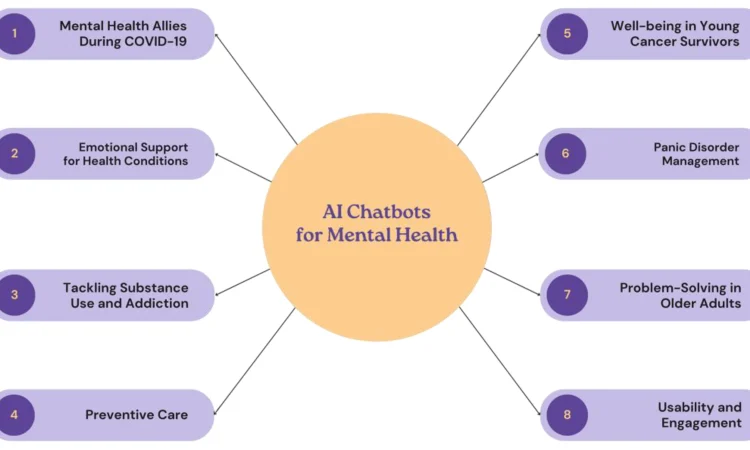
Another area where AI is making a visible impact is therapy chatbots and digital companions. These tools provide 24/7 emotional support, offering a judgment-free space for users to express their feelings. While these chatbots cannot replicate the empathy and clinical expertise of a human therapist, they can assist with:
- Cognitive Behavioral Therapy (CBT) exercises
- Stress management techniques
- Guided meditations
- Journaling prompts
- Mood tracking
- Crisis support pathways
Mental health professionals acknowledge that many people hesitate to seek therapy because of stigma, cost, or time constraints. AI chatbots bridge this gap by giving individuals a safe entry point to begin exploring their mental health needs.
Importantly, experts emphasize that AI chatbots should serve as supplements—not substitutes. Their role is to offer immediate support, help users regulate emotions, and encourage them to seek formal treatment when necessary.
Reducing Barriers to Access
Across many countries, including developing regions, mental health services remain severely limited. There may be long waiting lists, a shortage of specialists, or clinics located far from rural areas. AI tools help reduce these barriers by scaling mental health support in ways that were previously impossible.
Teletherapy platforms enhanced with AI can match patients with therapists based on symptoms, personality, and treatment preferences—improving the likelihood of a successful therapeutic alliance. Automated language translation tools allow therapists to reach culturally and linguistically diverse populations with far greater accuracy.
In addition, AI screening tools can be deployed in schools, workplaces, or community centers to help identify individuals who may need mental health assistance. This early identification is crucial in preventing long-term psychological decline.
AI in Diagnostics: Faster and More Accurate Insights
Mental health diagnosis has traditionally been based on clinical interviews and subjective observations. While experts are highly skilled, human interpretation can sometimes miss hidden symptoms or biases. AI adds a new layer of precision.
Researchers have developed algorithms capable of analyzing biological markers, brain imaging data, and digital behaviors to detect patterns associated with conditions like depression, bipolar disorder, ADHD, and PTSD. These systems complement clinical judgment, providing therapists with additional perspectives that can lead to more accurate diagnoses.
For example:
- Natural language processing tools can evaluate speech for signs of cognitive decline
- Machine-learning models can analyze sleep data to identify disruptions linked to mood disorders
- Typing rhythms on smartphones may indicate mental stress
Although these technologies are still evolving, many experts believe AI-assisted diagnostics may one day become a standard component of mental health assessments.
Ethical Challenges: Privacy, Bias, and Human Trust
While the benefits are significant, experts also caution that AI in mental health comes with serious ethical considerations.
- Privacy is a major concern due to sensitive data usage
- Bias in training data can lead to inaccurate assessments
- Trust issues arise when users hesitate to confide in AI tools
Experts stress that ethical guidelines, transparent practices, and strict data governance must be established before large-scale implementation.
Human Therapists + AI: A Powerful Partnership
Despite concerns, most mental health professionals agree that the future of treatment lies in a hybrid model where AI and human therapists work collaboratively.
In this framework:
- AI handles data analysis, monitoring, and pattern recognition
- Therapists provide emotional insight, clinical judgment, and personalized guidance
This partnership allows clinicians to focus their time on deeper therapeutic work while AI assists with administrative tasks, assessments, and tracking progress between sessions.
Early research shows that patients often achieve better outcomes when supported by both digital tools and human therapy. AI brings consistency and precision; humans bring empathy and relational connection.
The Road Ahead
The question isn’t whether AI can improve mental health treatment—it already is. The real question is how society will shape its development to ensure it is safe, ethical, and accessible to all.
As AI becomes more sophisticated, experts envision a future where mental health care is proactive rather than reactive. Imagine a world where emotional distress is detected early, support is available instantly, and treatment is tailored uniquely to each person’s needs.
In this rapidly evolving landscape, AI stands not as a replacement for human therapists but as a powerful ally. Together, they have the potential to expand access, enhance treatment quality, and improve the emotional well-being of millions worldwide.








