
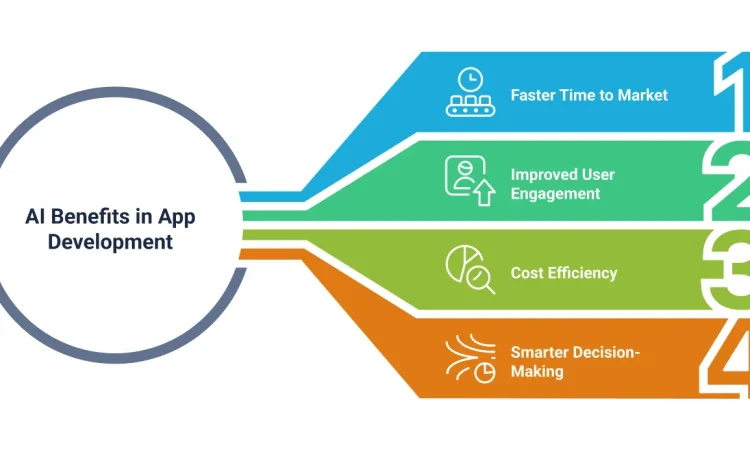
The world of software development is moving faster than ever, and one major force is driving this change—artificial intelligence. Tasks that once took weeks of coding, debugging, and performance tuning can now be handled in a fraction of the time. AI has evolved from a support tool into a core element of the development process, helping teams work smarter, move quicker, and build stronger applications.
Today, AI sits at the heart of modern workflows. Whether it’s writing code, catching bugs, or automating testing, AI is reducing repetitive work, minimizing errors, and giving developers more time to focus on meaningful problem-solving.
A New Era of Coding Assistance
AI-powered coding assistants are one of the clearest signs of this transformation. These tools don’t just autocomplete code—they understand context, follow patterns, and even create entire functions from scratch.
Developers no longer have to spend hours hunting through documentation or browsing forums. Instead, they get real-time suggestions that match the project’s style and structure. This boosts accuracy, speeds up development, and lowers the risk of introducing common mistakes.
What makes these tools even more powerful is their ability to learn. As developers work, the AI studies the architecture and naming conventions to better predict future needs. The longer it’s used, the more intuitive and helpful it becomes.
Smarter Debugging With Predictive Insights
Debugging has always been one of the toughest and slowest parts of development. Finding the root cause of a single bug in thousands of lines of code can feel like looking for a needle in a haystack.
AI is changing that.
Modern debugging tools analyze logs, trace error paths, and compare behavior patterns from countless coding scenarios. Instead of slogging through trial and error, developers now receive intelligent hints on where problems originate and how to fix them.
These systems can also spot vulnerabilities, memory issues, and performance concerns before they grow into major incidents. The result is both faster debugging and a proactive approach to maintaining code quality.
Automated Testing: From Days to Minutes
Testing is essential, but writing and updating tests often slows teams down. AI brings powerful automation to this stage.
AI-driven testing platforms can generate test cases automatically based on user behaviors, code updates, and past performance trends. They also simulate real-world scenarios, flag weak points, and adapt tests as the application changes.
This allows teams to run complete test cycles in minutes instead of days. Faster testing means faster releases—and without sacrificing reliability.
For scaling applications with growing user bases, this adaptive testing is especially valuable. It keeps systems resilient even as they evolve.
Revolutionizing Project Management and Productivity
AI isn’t just improving code—it’s improving how development teams work together.
Predictive analytics now help project managers understand timelines more accurately by examining team performance, task complexity, and historical trends. This makes it easier to forecast delays, manage risks, and assign tasks to the people best suited for them.
AI can also handle repetitive administrative work like sorting tickets, generating documentation, or pulling insights from knowledge bases. This frees teams from low-value tasks and keeps them focused on what matters.
AI and DevOps: Speeding Up Delivery Pipelines
DevOps depends on fast, reliable, and continuous delivery. AI integrates seamlessly into these pipelines to automate everything from testing and deployment to monitoring and rollback.
AI-powered monitoring tools detect unusual activity long before users notice an issue. They predict downtime, identify overload risks, and make it easier for teams to act immediately.
In CI/CD pipelines, AI recommends optimization strategies, reduces build times, and determines the best times to push updates. It even helps guide incident response by suggesting fixes in real time.
Bridging Skills Gaps for New Developers
AI is also helping newcomers enter the industry with confidence.
Beginners can get instant explanations, alternative solutions, or simplified breakdowns of complex concepts. This reduces the pressure of constantly relying on senior developers.
AI-based learning systems track progress, identify knowledge gaps, and tailor lessons to individual needs. This speeds up onboarding and helps new developers grow faster.
Building More Secure Applications
Security remains one of the biggest challenges in software development—and AI is becoming an essential layer of defense.
By analyzing millions of vulnerabilities and attack patterns, AI can detect risks early in the development cycle. It highlights outdated libraries, insecure coding practices, and suspicious API behavior.
AI can even generate secure code snippets that follow best practices. And because cyberthreats evolve constantly, AI continues learning and adapting to new attack vectors.
The Human-AI Partnership: Collaboration, Not Replacement
A major concern for many developers is whether AI will take over their jobs. In reality, AI acts as a partner—not a replacement.
Developers still bring the creativity, architectural thinking, and strategic decision-making that machines can’t replicate. What AI does is remove repetitive tasks so developers can focus on innovation, performance, and user experience.
The result is a more empowered, more efficient development process.
The Road Ahead: A Smarter, More Efficient Future
AI’s influence on software development is only going to grow. Future systems may understand user needs before they’re expressed, generate whole applications automatically, or evolve software based on real-world usage.
One thing is certain: AI is no longer optional. It’s a game-changer shaping the next era of development.
Teams that adopt AI today will be the ones building the fastest, smartest, and most innovative software of tomorrow.








