
Artificial intelligence (AI) has rapidly evolved from a niche field into a global phenomenon. Today, it captures the imagination of investors, entrepreneurs, and the general public alike. Multi-billion-dollar funding rounds, groundbreaking innovations in generative AI, and companies racing to launch AI-powered products dominate headlines almost daily.
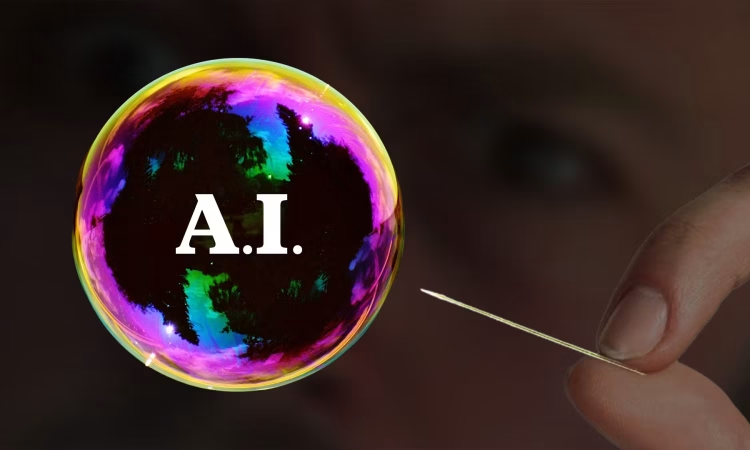
Yet, amid this excitement, whispers of an AI “bubble” have grown louder. Skeptics warn about overvalued startups, inflated expectations, and the potential for a market correction reminiscent of the dot-com crash of the early 2000s.
But calling AI a bubble might oversimplify the situation. A more nuanced perspective can help us understand the current hype and its long-term potential. To do so, we need to explore both the factors driving excitement and the realities of AI adoption.
The Anatomy of the AI Hype
AI has become a magnet for capital. Global investment in AI startups has surged dramatically in recent years, often surpassing growth in other tech sectors. This has led to sky-high valuations—even for early-stage companies. Media coverage amplifies the excitement, highlighting breakthroughs in language models, robotics, and automation.
Much of this hype is justified. AI has advanced faster than many predicted just a decade ago. Natural language processing, computer vision, and reinforcement learning now power applications ranging from chatbots that can hold conversations to self-driving prototypes and AI-assisted drug discovery. The potential benefits for businesses and consumers seem almost limitless.
However, there is often a gap between hype and tangible results. Many startups are still refining products, scaling infrastructure, and navigating complex regulations. Investors, driven by fear of missing out, sometimes overlook these challenges, inflating valuations and creating the perception of a speculative bubble.
Rethinking the Bubble Metaphor
The term “bubble” suggests an inevitable collapse, where valuations vastly exceed reality and investors suffer massive losses. While parts of this dynamic exist in the AI sector, the technology itself is fundamentally different from previous bubble-prone markets. Unlike the dot-com era, where many companies offered little more than a website, AI development is built on research, intellectual property, and scalable systems.
Even if AI valuations experience a correction, the technology itself doesn’t disappear. AI tools, platforms, and frameworks retain utility and continue driving innovation. This means a reevaluation of valuations could be healthy, weeding out companies without solid fundamentals while letting genuinely transformative ventures thrive.
Understanding the Drivers of Overvaluation
Several factors contribute to inflated AI valuations:
- The Hype Cycle: Early excitement about new AI capabilities generates disproportionate attention and funding. Breakthrough announcements can spark sudden surges in interest—even before the technology is fully validated.
- Cross-Industry Promise: AI touches multiple sectors, from healthcare to finance to logistics. Investors may assume that success in one area will generalize to others, leading to overly optimistic projections.
- Fear of Missing Out (FOMO): History shows that early movers in tech booms often reap outsized rewards. In AI, this drives rapid investments, talent acquisition, and product launches, sometimes at the expense of careful evaluation.
A More Productive Perspective
Instead of viewing AI as a bubble waiting to burst, it’s more useful to see it as a period of “market fever” for transformative technology. Valuations may be high, and some projects might fail—but AI is reshaping industries, labor markets, and innovation processes.
For entrepreneurs, this means focusing on long-term value:
- Build robust AI systems.
- Ensure ethical deployment.
- Demonstrate measurable outcomes.
For investors, the focus should be on distinguishing between hype and genuine technological progress, identifying companies with sustainable business models.
Policy makers and regulators also play a crucial role. Thoughtful oversight can prevent excesses while encouraging innovation, ensuring AI contributes to societal welfare rather than generating fleeting financial excitement. In this sense, what some see as a bubble may actually act as a natural filter, separating well-founded innovation from superficial speculation.
Learning From History Without Being Paralyzed by It
Technology bubbles—from railroads to dot-coms—offer both cautionary tales and lessons in resilience. The dot-com collapse eliminated weak players but paved the way for enduring giants like Amazon, Google, and eBay.
AI may follow a similar path. Market corrections could be painful, but they won’t erase the technological progress already made. Companies that leverage AI effectively, build proprietary expertise, and align innovations with real-world needs are likely to emerge stronger from any turbulence.
The Human Element
One often-overlooked factor in AI discussions is the human element. AI doesn’t operate on its own—it’s built, trained, and applied by people. Decisions in product design, strategy, and investment ultimately determine the success of AI initiatives.
This means careful judgment, informed skepticism, and thoughtful experimentation are far more important than blind enthusiasm. The AI moment is as much about human decision-making as it is about algorithms. A balanced perspective emphasizes learning, adaptation, and strategic thinking in a rapidly changing landscape.
Conclusion
The idea of an AI bubble is tempting—it promises a simple narrative of hype, overvaluation, and inevitable collapse. Yet this oversimplifies a complex reality. AI is not a passing trend; it’s reshaping how knowledge is created, decisions are made, and industries operate.
A more productive way to view the AI bubble is as a phase of market fever within a broader technological transformation. Yes, valuations may fluctuate, and some ventures may fail. But the underlying technology, skills, and applications are real, lasting, and impactful.
By focusing on value creation, ethical deployment, and long-term innovation, businesses, investors, and society can turn what some fear as a bubble into a lasting opportunity for growth. The AI moment is not just a cautionary tale—it’s a chance to redefine how we think about technology, investment, and human ingenuity in the 21st century.








