
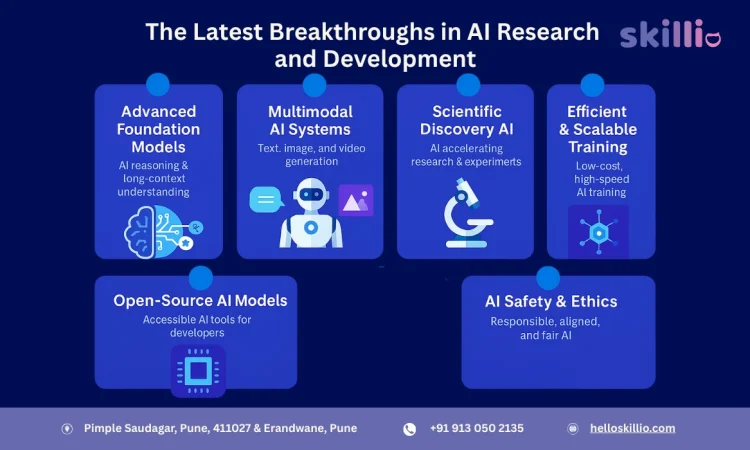
Artificial Intelligence (AI) has quickly evolved from a futuristic concept into the backbone of today’s technological progress. As we move through 2025, the world stands at the forefront of an AI-powered era that’s reshaping industries, economies, and everyday life.
From cutting-edge generative models and autonomous systems to ethical governance and creative partnerships, this year marks one of the most transformative periods in AI’s journey.
Below, we take a closer look at the most significant AI breakthroughs and innovations shaping 2025.
1. Generative AI Enters Its Mature Phase
The last few years saw a boom in generative AI — systems capable of creating text, art, music, and even code. In 2025, this technology has reached an entirely new level of maturity.
Modern multi-modal AI models now blend text, speech, image, and video generation seamlessly, operating as unified intelligent systems.
These next-gen models do more than just produce human-like responses — they understand context, emotion, and tone. For instance, AI writing tools can now craft long-form stories that match a reader’s preferred style, while visual design AIs help creators produce entire product lines or virtual environments with minimal human input.
But generative AI isn’t limited to content. It’s also revolutionizing industries like urban planning, climate forecasting, and pharmaceutical research, dramatically cutting research and development timelines.
2. AI in Healthcare: Precision Medicine Becomes Reality
Healthcare remains one of AI’s most promising frontiers, and in 2025, precision medicine has become a reality.
By integrating genomic data, wearable sensors, and predictive analytics, doctors can now detect health risks early and tailor treatments to each patient’s unique genetic profile.
AI-assisted diagnostic tools have also made massive leaps — detecting diseases such as cancer, heart conditions, and neurological disorders long before traditional methods can. Hospitals are using AI-driven triage systems to manage patients efficiently, reduce human error, and improve overall care quality.
Mental health care has also seen innovation. Emotion-recognition algorithms and conversational therapy bots now help identify early signs of stress, anxiety, or depression, ensuring that support reaches people when they need it most.
3. Autonomous Systems Redefine Mobility and Robotics
Autonomous technology has grown far beyond self-driving cars. In 2025, drones, delivery robots, and industrial machines are revolutionizing sectors like logistics, agriculture, and manufacturing.
Fully autonomous public transport is now being tested in multiple cities. With the help of AI and IoT integration, vehicles communicate in real time, reducing accidents, conserving fuel, and easing traffic congestion.
In industries, collaborative robots (cobots) are working side by side with humans — learning tasks through real-time reinforcement learning. In agriculture, robots are using computer vision and predictive models to optimize crop yields, monitor soil health, and automate harvesting.
These developments are driving efficiency, safety, and sustainability across sectors.
4. AI Governance and Ethics Take Center Stage
With AI advancing rapidly, 2025 has also become a landmark year for ethical AI governance.
Global collaboration between governments, researchers, and corporations has led to the creation of standardized frameworks ensuring AI remains transparent, fair, and accountable.
The European Union’s AI Act, launched earlier this year, has set a global standard by emphasizing data privacy, algorithmic transparency, and user safety.
At the same time, a growing focus on Explainable AI (XAI) is helping users understand how AI systems make decisions — a crucial step for trust in industries like healthcare, finance, and law enforcement.
The ethical conversation now includes environmental responsibility, too. As large AI models consume massive energy, the focus has shifted to green AI — designing energy-efficient algorithms and promoting sustainable computing.
5. AI and Creativity: A New Frontier for Collaboration
AI is no longer seen as a replacement for human creativity but as a powerful collaborator.
Musicians use AI to create harmonies and blend genres, while filmmakers leverage it for scriptwriting, visual effects, and interactive storytelling that adapts in real time to viewer feedback.
In fashion and architecture, AI analyzes design data to forecast trends, optimize materials, and suggest bold new concepts.
This partnership between humans and machines is redefining creativity — proving that AI can enhance, not erase, human imagination.
6. AI in Education: Personalized and Immersive Learning
Education has been completely reimagined through AI in 2025.
Intelligent tutoring systems now provide hyper-personalized learning paths, adapting to each student’s pace and style. Virtual classrooms, powered by AI and AR/VR technologies, make complex subjects like science, history, and engineering come alive through interactive, real-world simulations.
For teachers, AI automates grading, manages administrative tasks, and even tracks engagement to provide real-time classroom insights. This shift lets educators focus more on mentoring, creativity, and critical thinking.
The result? Smarter teaching, deeper learning, and more equal access to education for all.
7. The Rise of AI Agents and Digital Companions
2025 is witnessing a surge in intelligent digital agents — AI systems that autonomously perform tasks on behalf of users.
These are not simple chatbots. They can manage emails, schedule meetings, book travel, handle shopping, and even coordinate business operations.
In workplaces, AI assistants summarize meetings, manage workflows, and analyze data for strategic decisions. At home, AI companions personalize entertainment, manage home energy, and even help plan family routines.
As humans and AI work increasingly hand in hand, these systems are becoming trusted digital partners in both personal and professional life.
8. Quantum AI and the Future of Intelligence
Perhaps the most groundbreaking innovation of 2025 lies in Quantum AI — the convergence of artificial intelligence and quantum computing.
By using quantum computers’ immense processing power, researchers are now solving complex problems in seconds that once took years. This has led to breakthroughs in drug discovery, materials science, and climate modeling.
Although still limited to research institutions and select enterprises, Quantum AI’s potential is enormous. Experts predict it could usher in a new era of machine intelligence — one that completely transforms computation, science, and innovation.
Conclusion: The Dawn of a New Intelligence Era
The AI developments of 2025 prove that artificial intelligence is no longer science fiction — it’s a living force shaping our world.
From personalized medicine and sustainable automation to artistic collaboration and ethical oversight, AI is driving progress in every field imaginable.
But with progress comes responsibility. The real test now is ensuring that AI continues to grow ethically, inclusively, and sustainably — serving humanity, not replacing it.
As we step further into this new age of intelligence, one truth stands clear: AI is not just the future — it’s the present, and it’s redefining what’s possible.








