
What the Future Workforce Looks Like With Artificial Intelligence
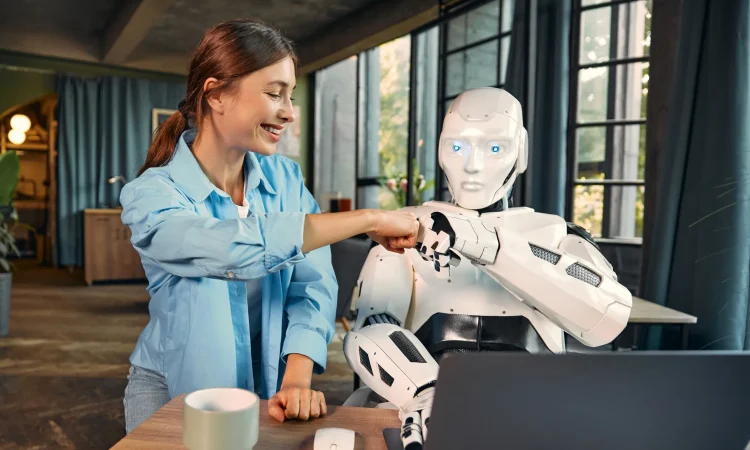
Artificial Intelligence (AI) is no longer a futuristic idea — it’s already woven into how we work, learn, and collaborate. From automating repetitive tasks to driving smarter decision-making, AI is transforming industries and redefining the meaning of work itself. As we stand at the crossroads of human creativity and machine intelligence, one big question arises: what will the future workforce look like with AI?
The Changing Nature of Work
The workplace of tomorrow won’t be defined by how many humans it employs, but by how well humans and machines work together. AI can now analyze data, recognize patterns, predict trends, and even understand language — tasks that once required human judgment.
But this isn’t about replacing people — it’s about enhancing human potential and creating new types of jobs.
Repetitive, rule-based tasks are the first to be automated. Sectors like manufacturing, logistics, and data entry are already seeing this shift. Yet, instead of leading to mass unemployment, AI is freeing people to focus on more creative, strategic, and emotionally intelligent work — the kind that demands innovation, empathy, and problem-solving.
A New Wave of Hybrid Roles
Job titles are evolving as AI becomes a workplace partner. Roles such as AI Trainer, Data Ethicist, Robotics Coordinator, and Machine Learning Operations (MLOps) Specialist are emerging across industries.
These positions blend technical know-how with domain expertise — ensuring AI systems are guided, monitored, and improved by human insight.
For instance:
- An AI Trainer teaches algorithms how to interpret human behavior or speech.
- A Data Ethicist ensures algorithms are fair, transparent, and unbiased.
Existing roles are also changing. Marketers use predictive analytics to understand customers. Doctors rely on AI to assist in diagnoses. Financial analysts depend on algorithms to detect fraud and optimize portfolios. In every field, professionals are learning to work with AI, not around it.
The Rise of Continuous Learning and Reskilling
In an AI-powered world, one skill stands above all others: the ability to keep learning.
Technical skills now have a much shorter shelf life. Workers must constantly adapt to new technologies, tools, and workflows. Educational institutions, companies, and governments are responding with training programs designed to reskill and upskill workers for the AI era.
- Universities are introducing AI literacy into core curricula.
- Businesses are investing in digital learning platforms.
- Governments are funding national initiatives to prepare citizens for future jobs.
Soft skills are becoming equally essential. Empathy, creativity, communication, and leadership — the traits that make us human — are more valuable than ever. The professionals who combine technical literacy with emotional intelligence will thrive.
AI as a Collaborative Colleague
The future workplace will center around augmented intelligence — humans and AI working hand in hand.
Rather than replacing workers, AI will act as a digital teammate that manages data-heavy or time-consuming tasks while humans focus on judgment, strategy, and creativity.
Examples include:
- Customer service: AI chatbots handle basic questions so humans can focus on empathy-driven interactions.
- Healthcare: AI analyzes medical scans, giving doctors more time for patient care.
- Creative fields: AI tools generate design ideas or assist in composing music, allowing artists to explore new possibilities.
This collaboration boosts efficiency, accuracy, and innovation — but it also humanizes the workplace by reducing routine workload and giving people more space for meaningful work.
Ethical and Social Implications
As AI takes root in workplaces worldwide, it brings serious ethical and social questions:
- How can we make sure automation benefits everyone, not just a few?
- How do we protect workers in industries most affected by AI?
To build a fair and inclusive AI-powered workforce, governments and organizations must:
- Promote responsible AI policies and transparency.
- Ensure algorithmic fairness and prevent bias.
- Provide support systems for workers transitioning to new roles.
Diversity is also crucial. A diverse AI workforce helps create systems that are inclusive and representative of all people. Building ethical AI isn’t just a technical task — it’s a moral obligation.
The Global Workforce and Remote Collaboration
AI has redefined not only what we do but also where we do it.
Automation and AI-powered collaboration tools have made remote and hybrid work more effective than ever. Teams can now coordinate projects, track performance, and communicate seamlessly across continents.
This shift offers tremendous benefits:
- Flexibility: People can work from anywhere.
- Access: Companies can hire global talent.
- Efficiency: AI tools optimize workflows across time zones.
However, challenges like maintaining work-life balance and ensuring digital equality remain. To make AI-driven work inclusive, we must bridge the digital divide so opportunities are shared globally — not concentrated in a few regions.
The Human Touch in an AI-Driven World
AI may simulate intelligence, but it can’t replicate human experience. Empathy, moral judgment, and creativity are uniquely human strengths — and they will define the future workforce.
Leaders of tomorrow will not only manage people or technology — they will manage the relationship between both. The future of work will be driven by purpose, adaptability, and collaboration.
The real challenge isn’t resisting AI — it’s embracing it responsibly, using it to enhance human potential rather than replace it.
Looking Ahead
The rise of AI represents one of the greatest transformations in human history. Just as the Industrial Revolution reshaped physical labor, the AI revolution is transforming cognitive work.
But this time, we have foresight — and the chance to shape it wisely.
By investing in education, ethics, and collaboration, we can create a workforce that thrives alongside AI. The goal isn’t to let machines take over — it’s to ensure that humans and AI work together to build a smarter, fairer, and more innovative world.
In the end, the future workforce won’t be purely human or purely artificial — it will be intelligently human, where technology amplifies what we do best: think, create, and care.








