
Top 5 Programming Languages for Artificial Intelligence Development
In today’s fast-changing digital world, Artificial Intelligence (AI) is one of the most powerful forces shaping the future. From self-driving cars and virtual assistants to predictive analytics and healthcare innovations, AI has become deeply embedded in everyday life.
At the core of every intelligent system lies a programming language — the foundation that allows developers to design, train, and deploy AI models. Choosing the right language isn’t just about preference; it determines how efficient, scalable, and innovative an AI solution can be.
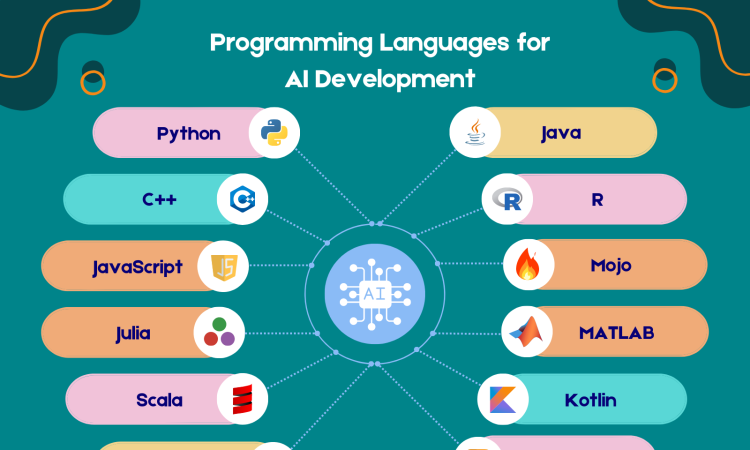
Here’s a closer look at the top five programming languages driving AI development and why they’re shaping the future of intelligent technology.
1. Python — The Undisputed Leader of AI Development
When it comes to AI and machine learning, Python reigns supreme. Its simplicity, flexibility, and massive ecosystem of libraries make it the top choice for developers and researchers across the globe.
Python’s clean, readable syntax helps developers focus on solving AI problems rather than wrestling with complicated code. Its powerful libraries — including TensorFlow, PyTorch, Keras, Scikit-learn, and Pandas — simplify everything from neural network design to data visualization.
The language also benefits from a strong global community, offering tutorials, forums, and regular updates that make experimentation easy for both beginners and professionals.
Why Python excels for AI:
- Simple and readable syntax for all skill levels
- Vast ecosystem of AI and machine learning libraries
- Strong community support and continuous development
- Excellent integration with data science and deep learning tools
2. R — The Statistician’s Powerhouse for AI
While Python often dominates headlines, R holds a strong position in data-driven AI development. Originally designed for statistical computing, R has evolved into a key tool for machine learning projects that demand detailed data analysis.
R shines when it comes to statistical modeling and visualization. With packages like Caret, RandomForest, and rpart, R enables developers to efficiently build predictive models and perform advanced analytics. It’s especially popular among researchers and data scientists who need precision and clarity in handling large datasets.
Why R is ideal for AI:
- Exceptional for data visualization and statistical analysis
- Strong machine learning and predictive modeling libraries
- Broad range of packages for data science applications
- Widely used in academic and research-focused AI projects
3. Java — The Backbone of Scalable AI Systems
Java has long been a cornerstone of the software world, and it continues to thrive in AI development thanks to its portability, robustness, and scalability.
With its “write once, run anywhere” principle, Java allows AI applications to function across multiple platforms. It’s perfect for enterprise-level AI systems such as fraud detection, recommendation engines, and intelligent chatbots.
AI developers also rely on Java libraries like Deeplearning4j, Weka, and MOA to implement machine learning and data mining algorithms efficiently. Its performance, multithreading capabilities, and security make it a trusted choice for large-scale AI deployments.
Why Java remains important for AI:
- Platform-independent and scalable
- Strong performance and memory management
- Powerful frameworks for ML and data analysis
- Ideal for enterprise-grade AI applications
4. C++ — The Choice for High-Performance AI
If speed and efficiency are priorities, C++ stands out. This language excels in performance-critical AI systems where real-time processing and hardware-level control are essential.
C++ is widely used in robotics, computer vision, and gaming AI, where milliseconds matter. Developers can directly manage memory and fine-tune algorithms for optimal performance, giving them an edge in building low-latency, high-speed applications.
Frameworks like MLPack, Dlib, and Shark enable advanced AI implementation in C++. In fact, many leading AI frameworks — including TensorFlow and PyTorch — rely on C++ at their core.
Why C++ is vital for AI development:
- Exceptional speed and computational performance
- Ideal for real-time and resource-intensive applications
- Provides direct control over memory and hardware
- Serves as the backbone for many modern AI frameworks
5. Julia — The Rising Star of AI Programming
Among newer languages, Julia is quickly making waves in the AI community. Combining the best features of Python, R, and C++, Julia offers the speed of C++ with the simplicity of Python — making it perfect for numerical and scientific computing.
Its just-in-time (JIT) compilation delivers impressive execution speeds, ideal for AI tasks involving large datasets and complex calculations. Julia’s native support for parallel and distributed computing allows developers to handle heavy workloads with ease.
Emerging libraries like Flux.jl and MLJ.jl make machine learning with Julia both fast and intuitive. And because Julia integrates smoothly with Python and C, it’s an excellent choice for researchers seeking flexibility without sacrificing performance.
Why Julia is emerging in AI:
- Combines simplicity with high computational power
- Perfect for numerical and scientific AI workloads
- Supports parallel and distributed computing
- Rapidly growing developer community and ecosystem
Conclusion
Building powerful AI systems isn’t just about creativity — it’s about choosing the right tools. Each programming language brings something unique to the table:
- Python leads with its simplicity and rich AI ecosystem.
- R excels in data visualization and statistical analysis.
- Java ensures scalability and enterprise reliability.
- C++ delivers unmatched speed and control.
- Julia paves the way for high-performance scientific computing.
Ultimately, the best programming language for AI depends on project goals, developer expertise, and system performance needs. Together, these languages form the foundation for intelligent machines that continue to redefine what technology can achieve.








