
Breaking AI Industry News – April 2025: Generative AI and ChatGPT Updates
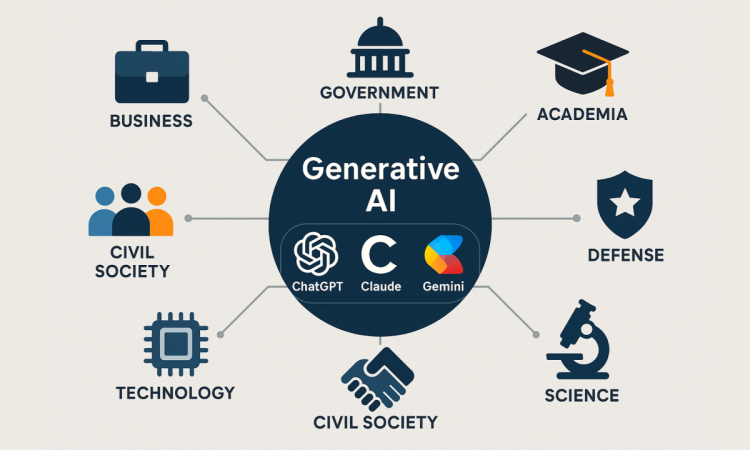
April 2025 has turned out to be another milestone month in the fast-moving world of Artificial Intelligence. Generative AI continues to dominate headlines globally — from new upgrades to OpenAI’s ChatGPT and Google’s Gemini to a wave of enterprise-ready AI tools transforming the creative and corporate worlds.
This month’s breakthroughs show just how deeply AI is embedding itself into our daily lives — influencing how we learn, work, communicate, and even how governments shape digital policy.
The Generative AI Boom Shows No Signs of Slowing Down
The generative AI revolution, powered by models that can craft text, images, music, and even videos, is accelerating like never before. Analysts report a 60% surge in adoption year-over-year across industries — from healthcare and marketing to software development and education.
April 2025 marked a key turning point, signaling a new era of personalized, multimodal, and context-driven AI systems. No longer confined to research labs, generative AI tools are now mainstream — integrated into everything from creative design apps and coding copilots to data analysis and content creation tools.
These systems are getting smarter, safer, and more intuitive — increasingly reflecting human values and understanding nuanced contexts more effectively.
ChatGPT Evolves: Smarter, Faster, and More Personal
OpenAI’s ChatGPT continues to lead the AI conversation. Its latest update brings major improvements in reasoning, accuracy, and memory. The model can now handle extended conversations with better recall, allowing users to pick up projects seamlessly across sessions — thanks to the new “persistent context” feature.
This upgrade makes ChatGPT feel less like a chatbot and more like a personalized digital companion — one that remembers preferences, ongoing tasks, and communication styles.
The model’s multimodal capabilities have also expanded, allowing it to interpret images, generate visuals, and integrate data-rich insights into text responses. From architects designing layouts to journalists visualizing data, professionals are already finding fresh, practical uses for these tools.
On top of that, OpenAI has strengthened safety filters and introduced real-time fact-checking mechanisms, ensuring more reliable, accurate, and transparent content generation.
Generative AI in Business: From Creativity to Efficiency
Across industries, AI is moving from experimentation to everyday execution. Companies are no longer testing — they’re integrating. Businesses are using generative AI to automate tasks like:
- Creating marketing content and reports
- Designing products and visuals
- Personalizing customer interactions
- Analyzing and summarizing complex data
In April, several Fortune 500 firms announced partnerships with AI providers to streamline operations and boost creativity. For example, retailers now use AI to produce customized campaigns in seconds, while financial institutions rely on AI to generate comprehensive reports instantly.
The creative industry is also undergoing a massive shift — scriptwriting, video production, and music composition are all being accelerated by AI. Still, questions around authorship, originality, and copyright remain critical, driving companies to set clearer rules on crediting and monetizing AI-generated work.
Rising Competition: Gemini, Claude, and Anthropic Step Up
Although ChatGPT continues to lead the market, competition in the generative AI field is heating up fast.
- Google’s Gemini recently rolled out a major update, improving real-time reasoning and seamless integration across Google Workspace tools. Users can now generate slides, reports, and predictive analytics directly within Docs, Sheets, or Slides.
- Anthropic’s Claude 3 series is also gaining traction for its commitment to safe, transparent AI through its “constitutional AI” approach — offering reasoning that’s explainable and ethically grounded.
Each company is carving out its space:
- OpenAI focuses on creativity and multimodal intelligence,
- Google emphasizes integration and scale,
- Anthropic prioritizes trust and interpretability.
This diversity is creating a vibrant, competitive landscape that benefits users and accelerates innovation across the board.
AI Policy and Regulation: Balancing Innovation and Responsibility
With rapid AI advancements come new regulatory challenges. Governments around the world are now shaping policies to balance innovation with accountability.
- The European Union’s AI Act is expected to take effect later this year, introducing strict transparency and data privacy standards.
- In the United States, lawmakers are drafting regulations to ensure that AI models remain auditable and respect copyright laws.
Major tech firms are also voluntarily adopting ethical frameworks, committing to disclose model capabilities, limitations, and safety evaluations before public release. Responsible AI is quickly becoming not just an ethical obligation, but a strategic advantage.
AI in Education, Research, and the Workforce
AI is transforming how people learn and work. In education, universities are adopting AI tutors that personalize lessons, provide instant feedback, and simulate lab experiences — improving accessibility, especially for students in remote regions.
In research, scientists are using generative AI to accelerate discovery — modeling climate data, predicting biological behavior, and exploring quantum computing applications faster than ever before.
The workplace is also evolving. As AI automates routine work, demand for AI literacy is rising. Skills like prompt engineering, data analytics, and AI oversight are becoming essential. Instead of replacing people, AI is amplifying human creativity and decision-making, leading to smarter, more efficient collaboration.
Looking Ahead: The Next Chapter of Human–AI Collaboration
As April 2025 closes, one message rings loud and clear — generative AI is entering its most transformative phase yet. What began as a novelty is now a necessity.
The future promises even more breakthroughs — from voice-driven assistants that understand tone and emotion to models that can reason across multiple domains simultaneously.
Generative AI isn’t just about creating smarter systems. It’s about empowering people — giving individuals, teams, and organizations the tools to think, create, and innovate like never before.
As human and artificial intelligence continue to evolve together, 2025 may well be remembered as the year when imagination, innovation, and intelligence truly merged.








