
Microsoft AI Debuts Its Nano Banana Rival — A New Top Text-to-Image Model Takes the Spotlight
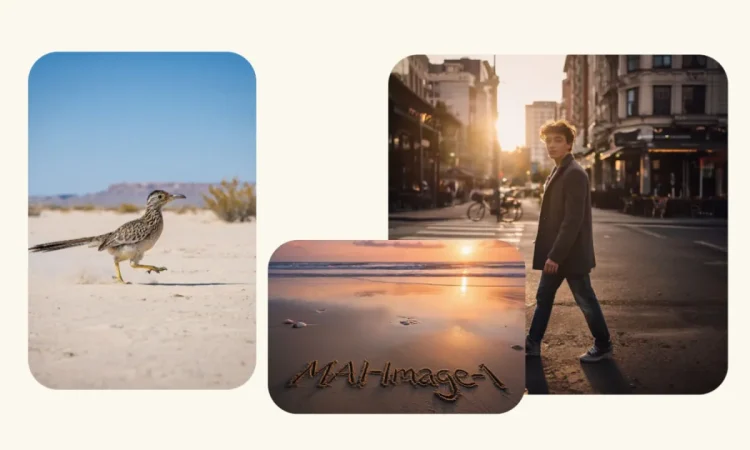
In a bold step that showcases Microsoft’s growing confidence in artificial intelligence, the company has unveiled its brand-new in-house text-to-image model, designed to rival Google’s much-hyped “Nano Banana.”
Internally known as MAI-Image-1, this next-generation AI system has already shaken up the industry—earning a Top 10 spot on LMArena’s leaderboard within just days of its debut. The milestone marks a defining moment for Microsoft as it moves from collaborating with AI pioneers to building its own high-performance models from the ground up.
A Strategic Shift for Microsoft
For years, Microsoft’s AI journey was closely tied to its partnership with OpenAI, the makers of ChatGPT and DALL·E. But with MAI-Image-1, the company is taking a clear step toward independence.
This model represents a multi-year research effort to merge Microsoft’s vast cloud computing power with cutting-edge visual AI innovation. Unlike third-party integrations, MAI-Image-1 is fully optimized to run natively on Microsoft’s own infrastructure—delivering faster processing speeds and enhanced efficiency compared to competitors.
Simply put, Microsoft is no longer just supporting AI—it’s shaping the technology itself.
Focused on Realism and Practical Creativity
While many AI image generators lean into abstract or artistic designs, MAI-Image-1 focuses on photorealism. It’s engineered to create lifelike images with natural lighting, accurate textures, and realistic reflections—ideal for real-world applications like marketing, product design, and visual content creation.
Early testers have praised the model for its ability to generate crisp, true-to-life visuals that strike a balance between creativity and practicality.
This is no accident. Microsoft collaborated closely with designers, photographers, and illustrators during development to ensure the model could handle creative tasks with precision and consistency, avoiding the overly stylized results that plague many AI art tools.
Creator-Guided Training: When Human Insight Shapes AI
One of MAI-Image-1’s biggest breakthroughs is its creator-guided training process. Instead of depending entirely on automated learning, Microsoft brought in real human creators to refine and guide the AI’s development.
These professionals offered feedback on thousands of generated images, helping the model learn how to capture not just what users ask for—but also the emotion, tone, and context behind each prompt.
For example, when asked to generate “a rainy city street at dusk,” the AI doesn’t just produce buildings and puddles—it captures the mood of the moment, from the glow of streetlights to reflections on wet pavement.
This human-in-the-loop approach makes MAI-Image-1 more intuitive, emotionally aware, and consistent in quality compared to earlier AI models.
Impressive Performance and Benchmarking
Upon launch, MAI-Image-1 soared to the Top 10 ranking on LMArena’s competitive leaderboard—an achievement that typically takes models months to reach.
Its score surpassed 1,000, a benchmark that highlights its technical strength. Reviewers praised its speed, generating high-quality images about 20% faster than major rivals, and its prompt accuracy, meaning it reliably produces images that align closely with user intent.
While benchmarks alone don’t define real-world performance, the results make it clear: Microsoft’s in-house model can go head-to-head with industry leaders like Google’s Imagen, Stability AI’s Stable Diffusion, and Midjourney.
Integration Across Microsoft’s Creative Ecosystem
MAI-Image-1 won’t remain a standalone product for long. Microsoft plans to seamlessly integrate it into tools across its ecosystem—bringing next-generation image generation to:
- Microsoft Copilot – for quick, visual content generation.
- PowerPoint – for creating presentation-ready visuals from text prompts.
- Bing Image Creator – for enhanced online image search and creation.
- Microsoft Designer – for marketing and design professionals seeking fast concept generation.
Imagine drafting a product ad in PowerPoint and instantly getting a fully realized image to match your idea. This kind of integration could redefine how millions of people create, collaborate, and communicate.
Taking On Google’s “Nano Banana”
Naturally, comparisons to Google’s “Nano Banana” are inevitable. While Google’s model is known for artistic creativity and stylistic flair, Microsoft’s MAI-Image-1 emphasizes control, precision, and real-world usability.
It’s designed for professionals and enterprises who need consistency, not just experimentation. That’s where Microsoft gains an edge—by focusing on reliability, scalability, and integration rather than novelty alone.
Industry experts believe this rivalry will push both companies to innovate faster, leading to smarter, more accessible AI tools for creators worldwide.
The Road Ahead: From Still Images to Moving Worlds
Microsoft’s ambitions don’t stop here. Insiders suggest that a successor—possibly called MAI-Image-2—is already in development, with features focused on personalization, video generation, and even 3D scene creation.
If successful, this could open doors to AI-powered animation, interactive storytelling, and real-time visual editing, all built atop Microsoft’s enterprise-grade AI infrastructure.
For users, that means more than faster tools—it signals a future where AI understands not only what you want to create but why.
A New Era of Visual Intelligence
With MAI-Image-1, Microsoft isn’t just joining the generative AI race—it’s redefining it. By combining in-house research, human creativity, and deep ecosystem integration, the company has positioned itself as a serious force in the world of AI-driven imagery.
This model goes beyond producing pictures—it’s about understanding imagination itself. As competition heats up between Microsoft, Google, and other AI leaders, one thing is clear: the future of digital creation will be powered by the partnership between human vision and machine intelligence.








