
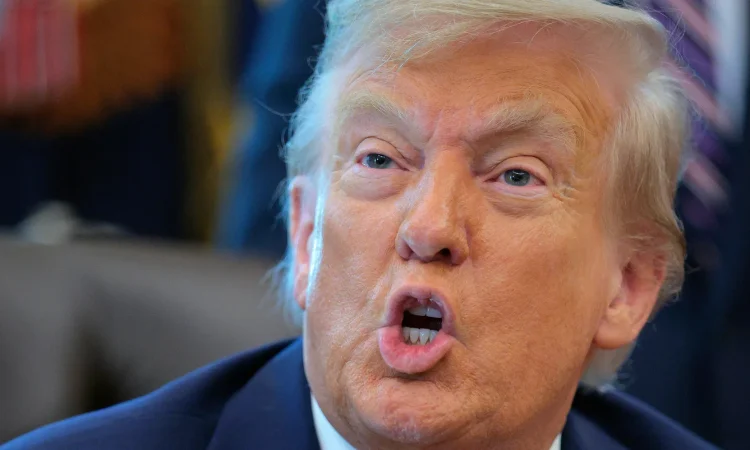
In a political world that is finding its feet in the digital age, technology is starting to impinge ever harder on politics. Technology recently took center stage in remarks by former U.S. President Donald Trump, after he made an eyebrow-raising comment about artificial intelligence (AI).
At a recent public appearance, Trump joked that any time “bad things happen,” he would simply “blame AI.” Delivered in his typical offhanded style, the remark has ignited a new round of debate about accountability, technology, and the role of AI in shaping public discussion.
A Joke or a Serious Signal?
Trump is a candidate whose provocative statements often live in the no-man’s land between sarcasm and policy suggestion.
- Supporters’ view: The comment read as a playful poke at the current obsession with AI.
- Critics’ view: Detractors saw it as yet another example of Trump’s reluctance to acknowledge responsibility, preferring instead to blame outside forces — real or imagined.
Artificial intelligence has taken the world by storm, and its swift rise has fueled widespread anxiety about potential dystopian consequences. By suggesting AI as a scapegoat, Trump highlights how the technology is increasingly not only a tool but also an entity that people conveniently blame.
Context Behind the Comment
The remark was made during a rally-style event where Trump addressed topics ranging from the economy and immigration to foreign policy.
When the conversation turned to technological change and its dangers, Trump quipped:
“When bad things happen, I’m just gonna blame AI.”
The audience responded with laughter and applause.
Although many dismissed the comment as a jest, some political analysts noted that Trump may have deliberately tapped into public anxieties about AI — fears tied to job losses, misinformation, deepfakes, and even national security threats.
The Politics of Blame
Trump has long faced criticism for his approach to accountability. During his presidency, he frequently pointed fingers at political opponents, the media, or international figures. In this context, blaming “AI” adds a futuristic twist to a familiar playbook.
- Symbolic: AI serves as an abstract, modern scapegoat.
- Strategic: The topic resonates with audiences already wary of technological disruption.
Critics argue that normalizing such rhetoric undermines serious conversations about AI governance.
“Making jokes about it and blaming AI is one thing, but there’s got to be real accountability for how technology is regulated and used by powerful people in this country,” one political commentator warned.
Others fear that such casual remarks contribute to a culture of diminished accountability rather than encouraging strong policy and oversight.
Public Reaction
Reactions to Trump’s quip were swift and divided, reflecting the polarization typical of his public remarks.
- Supporters’ take: Many saw it as a lighthearted break from the heavy, technical tone that often dominates discussions about AI. Online jokes quickly circulated, with some suggesting AI would soon need its own “press secretary” to respond to Trump.
- Critics’ take: Opponents warned that trivializing AI concerns risks undermining awareness of real dangers, from deepfake election meddling to discriminatory automated systems. For them, Trump’s words represented his broader tendency to minimize serious issues until they spiral out of control.
AI as the New Scapegoat
Blaming AI is not unique to Trump. In recent years:
- Corporations like Facebook and Uber have pinned mishaps on “algorithm errors” or “automated glitches.”
- Social media platforms have claimed their content-spreading algorithms are too complex for executives to fully control.
- Executives often describe job losses due to automation as “inevitable,” rather than the result of business decisions.
This trend reflects the anthropomorphizing of AI — treating it as if it were an independent decision-maker. Experts caution that while AI can yield unintended results, ultimate responsibility lies with the humans who design, deploy, and regulate these systems.
2024: What It Means for the Political Arena
With the 2024 election campaign heating up, Trump’s statement underscores how AI may feature prominently in political debates.
- Emerging issues: Deepfakes, disinformation, and election integrity are already central concerns.
- Strategic use: Some analysts see Trump’s remark as a pre-emptive rhetorical shield, allowing him to blame AI for future controversies, particularly in a media landscape complicated by AI-generated misinformation.
- Influence on voters: Given Trump’s reach, his dismissive stance could shape how millions of Americans perceive AI and accountability.
The Bigger Picture
Artificial intelligence is no longer a niche subject. It has entered the mainstream political and cultural arena, raising urgent questions about regulation, innovation, and accountability.
- Global response: World leaders are struggling to balance AI’s risks with its economic promise.
- U.S. actions: Lawmakers have held hearings, pressed tech CEOs for answers, and floated proposals for AI oversight.
Against this backdrop, Trump’s remark may appear trivial, but it symbolizes AI’s arrival in the national conversation — as both a punchline and a scapegoat.
Conclusion
Donald Trump’s quip about blaming AI when “bad things happen” may have been said with a throwaway tone, but its reverberations speak volumes.
In an era where AI is becoming deeply woven into daily life, how leaders talk about technology matters. While jokes can grab headlines, the real challenge lies in ensuring responsible development and governance of AI — without letting it become a universal scapegoat.
As the U.S. moves toward elections where AI will likely play an outsized role, Trump’s words highlight both public anxieties and the necessity of accountability. Whether seen as a joke, a warning, or a distraction, one thing is clear: AI has entered the political battleground, and its influence is only set to grow.








