
US Startup xLight Closes in on China for Groundbreaking Chipmaking Laser Tech With $40 Million Capital Infusion
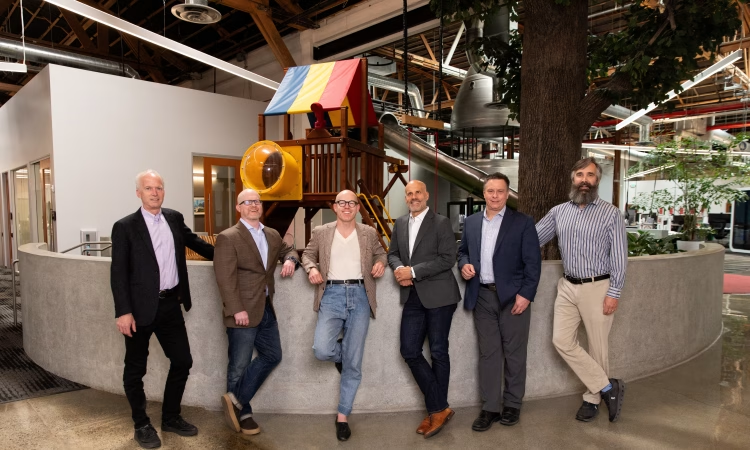
A U.S. semiconductor startup has reportedly closed a $40 million funding round to build laser technology for advanced chipmaking, a development that highlights how nation-states are increasingly competing in the semiconductor arena. The news arrives as the United States and China vie for supremacy in strategic semiconductors, with both government officials and private sector leaders prioritizing the restoration of tech sovereignty.
A Crucial Milestone for xLight
Established in 2022 by a group of optical engineers and semiconductor veterans, xLight has been quietly developing high-power laser systems that could become a key element in chip manufacturing — specifically, extreme ultraviolet (EUV) lithography.
- The $40 million infusion was led by top venture capital firms and strategic, government-backed investors.
- It represents a vote of confidence in xLight’s vision to upend an industry dominated by European and Asian providers.
“This funding is a game-changer,” said xLight CEO Anna Patel in a press release.
“It will allow us to speed up R&D timelines and production schedules, getting more chips into the hands of more Americans sooner — ensuring we no longer have to rely on foreign-manufactured semiconductors to power the critical systems of our economy.”
Why Lasers Matter in Chipmaking
The most advanced semiconductors are built through lithography — a process of etching microscopic patterns onto silicon wafers using light. Today’s cutting-edge chips require EUV lithography, which involves:
- Extremely short-wavelength light (13.5 nanometers)
- Feature sizes below 5 nanometers
Generating EUV light at an industrial scale requires laser-driven plasma light sources. This is where xLight comes in.
- The startup is developing compact, efficient, high-output lasers to serve as the primary light source for EUV machines.
- Currently, the technology is monopolized by Dutch company ASML, which relies heavily on suppliers from Japan and Germany.
xLight’s homegrown alternative aims to reduce the West’s dependence on fragile global supply chains, especially amid rising geopolitical tensions.
National Security and Economic Implications
Semiconductors have become a national security imperative. In recent years, the U.S. government has launched several programs to revive domestic chip production, most notably:
- The CHIPS and Science Act (2022), which allocated over $50 billion to U.S.-based semiconductor research, development, and manufacturing.
xLight’s funding aligns with this strategic vision:
- Some capital reportedly comes from quasi-governmental programs focused on critical technologies.
- The startup has also secured research funding from the Department of Energy and is in talks with defense agencies for potential collaborations.
“It’s not just about making chips better — it’s about staying ahead in technology,”
said Greg Hsu, semiconductor analyst at GlobalFoundries.
“If the U.S. can dominate the laser source for EUV, it would greatly reduce its strategic vulnerability in the chip supply chain.”
The China Factor
China’s aggressive push for a self-sufficient semiconductor ecosystem adds urgency to xLight’s mission.
- Over the past two years, Beijing has ramped up funding for domestic EUV lithography efforts.
- Though still behind in high-powered laser technology, China is advancing quickly — a trend that worries many in the West.
“China recognizes the strategic significance of lithographic lasers,”
said Lin Zhao, researcher at the Institute for Technology and Global Policy.
“They are making enormous investments in laser optics, metrology, beam shaping — everything needed to close the gap.”
xLight’s emergence is viewed as a counterbalance to China’s rise in this chokepoint technology.
Breakthroughs and Challenges Ahead
xLight has achieved encouraging lab results, with prototypes demonstrating the energy density and beam quality required for EUV applications.
The next steps include:
- Transitioning from prototype to commercial product
- Hiring engineers specializing in photonics and materials science
- Building a factory in the western United States
- Forming partnerships with optical component suppliers
Despite its progress, challenges remain. Scaling high-power lasers for volume production is extremely difficult.
“Making a laser powerful enough for EUV, yet compact and stable enough for 24/7 use, is a holy grail,”
said Dr. Luis Mendoza, optics professor at Caltech.
“If xLight can do it, that would be a landmark in photonics engineering.”
A New Player on the Global Stage
Although a small player compared to industry giants like ASML, xLight exemplifies how startups are driving innovation in critical technologies.
- If successful, xLight could disrupt the monopoly in EUV laser sources.
- The startup is already on the radar of major U.S. chipmakers, two of whom have expressed interest — pending testing and validation.
What’s Next?
In a fast-evolving industry, xLight’s trajectory could shape where and how next-generation chips are made.
- The company plans to ship beta laser modules to select partners by mid-2026.
- A full commercial rollout is expected in 2027.
With global attention on chip supply chains, xLight’s success could influence market dynamics and geopolitical power balances alike.
Conclusion: A Global Wager
xLight’s $40 million funding round is more than a financial win — it’s a strategic statement. As access to semiconductors becomes a key lever of economic and military power, xLight’s emergence signals the U.S.’s determination to secure technological independence.
In an age of high-performance computing, AI, autonomous vehicles, and next-gen communications, controlling the intellectual property behind chipmaking tools is critical. xLight’s laser technology is a bold bet — one that could reshape the global semiconductor landscape and help the U.S. reclaim its technological sovereignty for years to come.








