
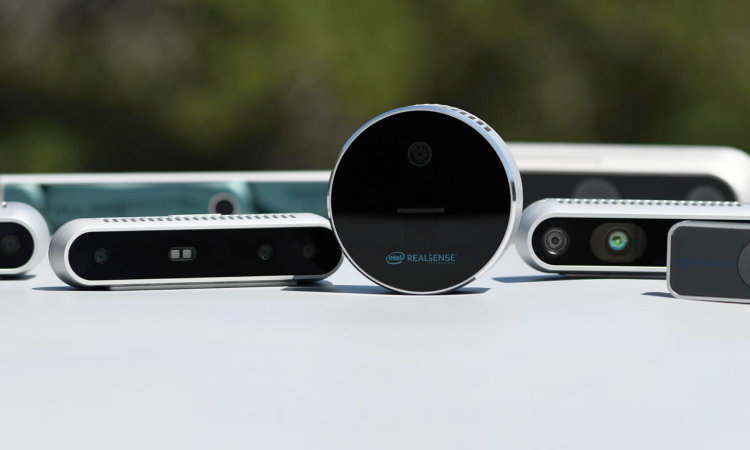
In something of a breakthrough for the world of computer vision and depth sensing, Intel’s RealSense division is officially being spun out to become its own independent company. The development represents a new beginning for a team that has developed some of the most sophisticated stereoscopic imaging technology in use today. Operating independently, RealSense will focus on accelerating innovation, expanding use cases, and reaching markets with its 3D imaging across a more extensive range of industries and applications.
A Legacy of Innovation at Intel
RealSense originated as a project inside Intel and was announced in 2014 with the goal of extending human-like 3D vision to devices. It led the field of compact 3D cameras that could measure depth (i.e., the distance of surfaces from a camera) and sense motion—allowing computers, robots, and other devices to effectively “see” the world similarly to humans.
Over the years, RealSense built a reputation as a leader in depth sensing, offering technologies applied in:
- Robotics
- Drones
- Facial recognition
- Navigation
- Retail automation
Devices like the D400 depth camera series and the Lidar-equipped L515 were well-received for their accuracy and integration flexibility.
However, despite its strong technological foundation, RealSense often remained on the periphery of Intel’s primary business focus, especially as the company doubled down on core operations such as semiconductor production, artificial intelligence (AI), and data centers.
Independence for Agility and Growth at the Spinout
The spinoff of RealSense is widely seen as a strategic divestiture by Intel and a significant opportunity for the RealSense team. As a standalone company, RealSense will have the ability to pivot quickly and scale its stereoscopic imaging business.
The new company is:
- Retaining the same engineering team and product direction that made it successful.
- Embracing the opportunity to innovate faster, more openly, and target new markets with agility.
In a statement, RealSense leadership shared:
“Being independent allows us to be more agile and better respond to customer needs… We are working on precision 3D perception technology to advance machine vision and improve how machines perceive the physical world.”
Continued Commitment to Depth Sensing
The spinout does not mean a departure from the groundbreaking technology that brought RealSense recognition. Instead, the company is planning to double down on its stereoscopic imaging platform.
Key commitments include:
- Continued support and updates for the D455 and D435 depth cameras.
- Development of a next-generation sensor line focused on performance, size, and power efficiency.
How It Works:
RealSense technology uses two cameras to capture stereo images, determining depth by comparing the differences between the two views—mimicking human binocular vision. This generates accurate, real-time depth maps, making it perfect for:
- Obstacle avoidance in autonomous robots
- Volumetric scanning
- Gesture recognition
As AI and robotics expand in both consumer and industrial applications, demand for affordable and reliable 3D sensing is rising. Freed from Intel’s corporate constraints, RealSense is now better positioned to meet that growing demand head-on.
Target Markets and Industry Applications
RealSense technology is already present in multiple industries, and the company intends to deepen its influence while exploring new frontiers.
1. Robotics and Automation
- Enables robots to navigate and interact with physical spaces.
- Commonly used in warehouse automation, delivery bots, and robotic arms in manufacturing.
2. Healthcare
- Supports applications such as patient monitoring and surgical assistance.
- Used in rehabilitation and physical therapy (PT) systems to analyze movement.
3. AR/VR and Gaming
- Delivers high spatial accuracy, essential for immersive experiences.
- Powers hand tracking, room mapping, and environmental interaction in AR/VR systems.
4. Smart Retail and Security
- Vital for people counting, gesture-based interfaces, and facial authentication.
- Enables touchless kiosks, smart checkout systems, and secure access control.
5. Drones and UAVs
- Essential for obstacle detection, flight stabilization, and terrain mapping.
- RealSense offers lightweight, power-efficient modules designed for easy drone integration.
With the ability to pursue new partnerships and third-party integrations, this independent RealSense aims to lead—and potentially dominate—the advanced imaging sector.
Leadership and Investment
The new company’s leadership includes veterans from Intel’s RealSense division, ensuring continuity in vision and execution.
Investment Highlights:
- Financial terms of the spinout are undisclosed.
- The company has raised funds from private investors and potentially strategic partners interested in machine vision technologies.
Although Intel will no longer manage RealSense, it may retain a minority stake or remain involved as a strategic technology partner, ensuring continuity in supply chains and research collaboration.
A Symbol of Broader Trends
The RealSense spinout reflects a larger trend in the tech industry: large companies spinning off niche or non-core units to give them the freedom to grow independently.
This strategy is a win-win:
- Parent companies gain operational focus.
- Spinouts gain agility, innovation potential, and market flexibility.
In recent years, similar moves have occurred across AI, hardware, and vision tech, as smaller, more focused firms often deliver faster and bolder innovations.
The Road Ahead
RealSense is stepping into this next phase as spatial computing, robotics, and AI are reshaping industries and the way machines interact with the real world.
With strategic partnerships underway and a culture of innovation, the newly independent RealSense is poised to take center stage in this technological transformation.
Success Factors:
- Maintaining a legacy of technical excellence
- Rapidly adapting to market needs
- Expanding its ecosystem through partnerships and custom solutions
For developers, hardware manufacturers, and industry pioneers, this spinout brings new levels of support, flexibility, and specialization. More importantly, for the broader world of computer vision, it reinforces the critical role of depth sensing as a foundational component of the next generation of intelligent machines.
Final Note:
While RealSense has long been a trailblazer under Intel, this new chapter promises a faster, more focused journey—one that may well redefine how machines see and understand the 3D world around them.








